


In this report
The NHL's map may be about to change again. In June 2026, the league entered a six-month evaluation process with the Friedkin family to explore a potential 33rd franchise in Houston or Austin. Commissioner Gary Bettman said the contemplated investment could reach roughly $3.5 billion, including an expansion fee and the cost of a new arena.
That makes a familiar question increasingly relevant: Where should the NHL go next? But perhaps that isn't quite the right question. Finding the largest North American city without an NHL franchise isn't enough. Neither is identifying the city with the strongest hockey culture, the biggest arena or the most people clamouring for a team.
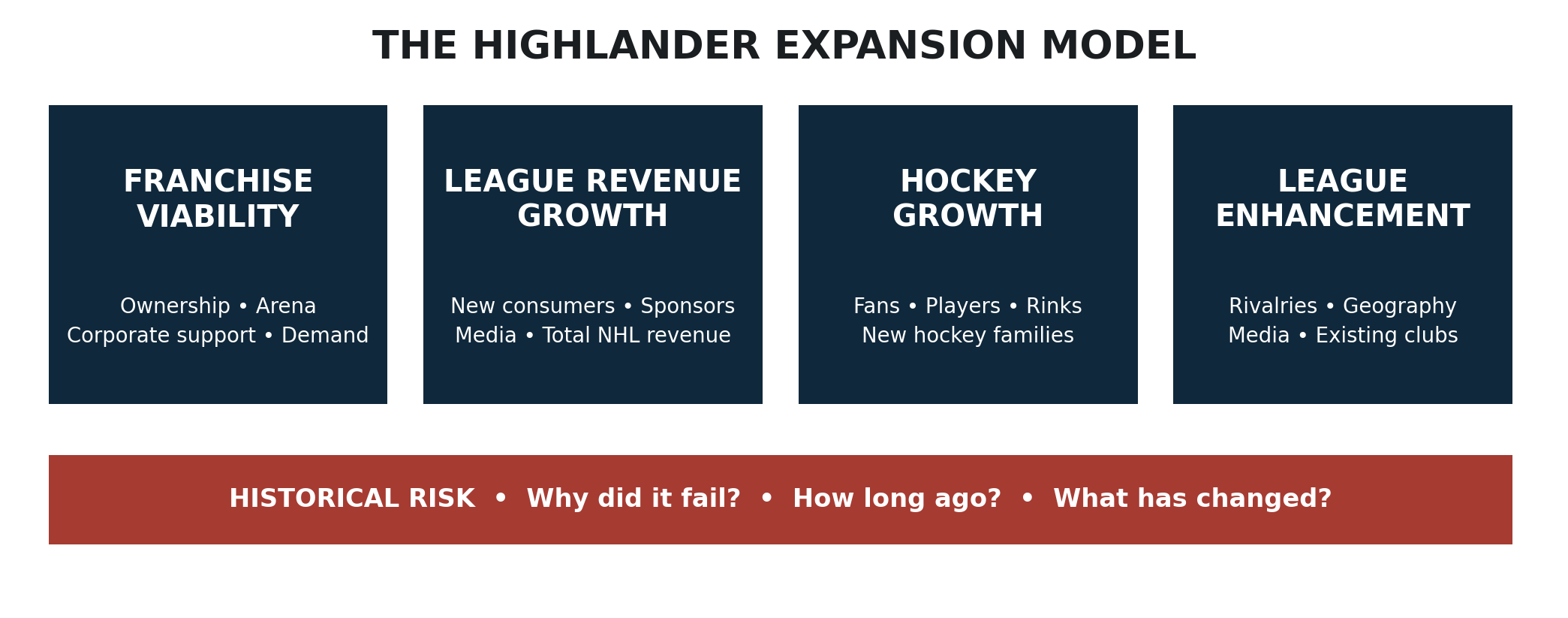
Expansion can accomplish different things. A new team can become a strong individual business, create new NHL consumers and league revenue, stimulate youth participation and rink development, fill a geographic hole, establish rivalries and potentially make nearby franchises more valuable. Or it can return the NHL to a community where virtually all of those hockey foundations already exist.
WHAT DOES THE NHL WANT ITS NEXT FRANCHISE TO ACCOMPLISH?
Open this graphic at full size
Four dimensions of expansion value, with historical risk applied across the model.
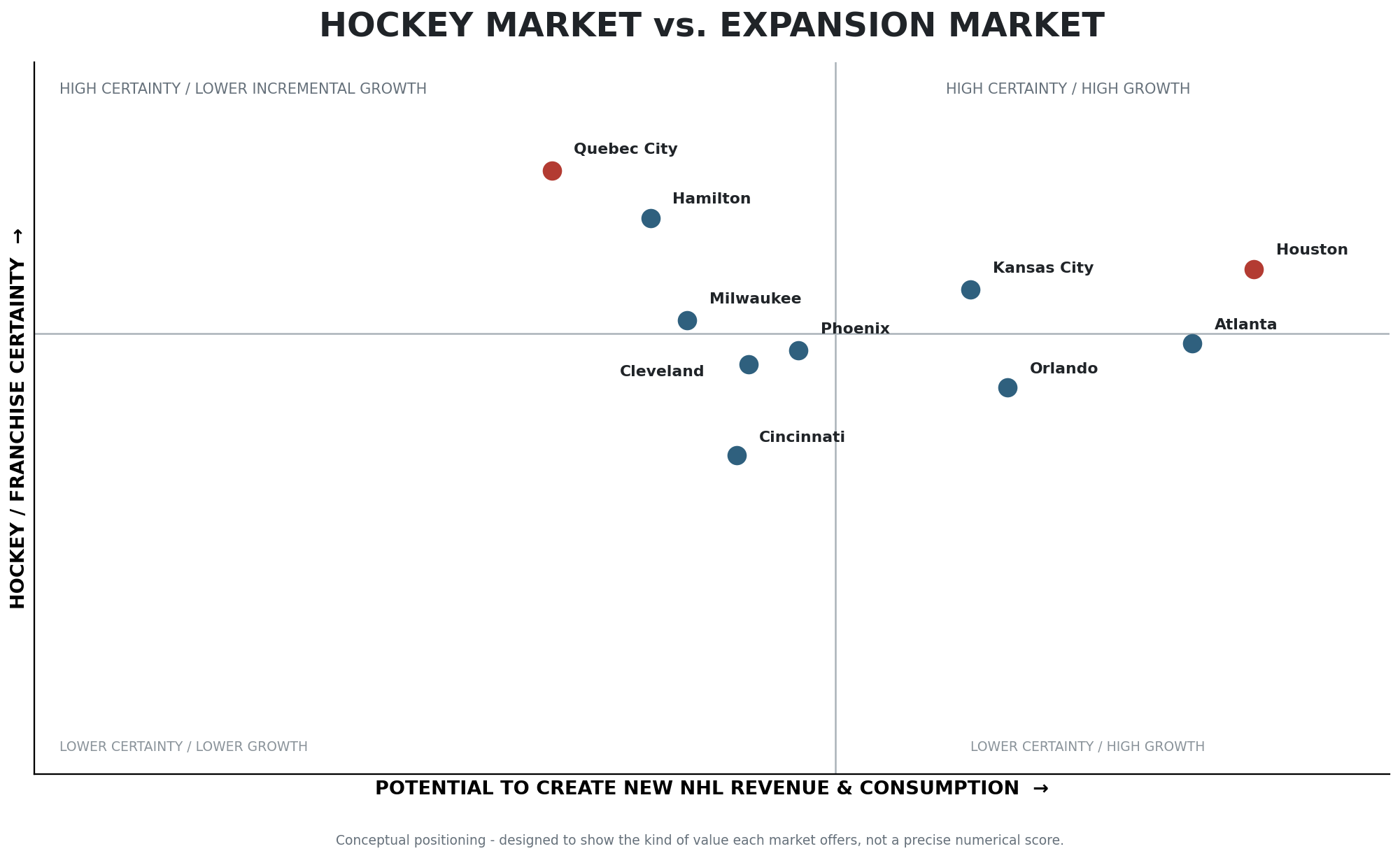
Hockey Market vs. Expansion Market
Quebec City illustrates the distinction almost perfectly. There is little reason to question whether Quebec could embrace an NHL franchise. It has hockey culture, history, an NHL-scale arena, an identity waiting to be revived and one of the sport's great dormant rivalries with Montreal.
Houston represents almost the opposite proposition. Its hockey foundation is considerably thinner, but the potential pool of new NHL consumers is enormous. For Quebec, the question is: Can an NHL franchise succeed here? For Houston, the question becomes larger: How much bigger can the NHL become by coming here?
That difference isn't only about growing hockey. It's about growing league revenue. A successful Nordiques franchise could generate substantial ticket, sponsorship, premium-seat, merchandise and local-media revenue. Quebec's ability to support NHL hockey isn't the issue. The harder question is how much of that revenue would be genuinely incremental to the league.
Many prospective Nordiques fans already watch NHL games, buy NHL merchandise and follow existing teams. Some spending captured by a new Quebec franchise could therefore represent NHL consumption moving from one club to another rather than entirely new consumption entering the league. Houston, Atlanta and Kansas City potentially offer millions of consumers and corporate partners in markets where the NHL has considerably more room to expand its economic footprint.
That matters beyond the expansion franchise. The NHL's payroll system is tied to league-wide economics; the 2026-27 upper limit is $104 million, while the league is projecting roughly $8.1 billion in revenue this season. A market capable of adding substantial new hockey-related revenue can help make the economic pie larger for the entire league.
THE QUESTION ISN’T ONLY “CAN THIS CITY SUPPORT A TEAM?” — IT’S “CAN THIS CITY HELP MAKE THE NHL BIGGER?”
The Highlander Top 10
Swipe or scroll across to see all columns.
| # | MARKET | FRANCHISE | GROWTH | DEFINING OPPORTUNITY | PRINCIPAL RISK |
|---|---|---|---|---|---|
| 1 | Houston | Very Strong | Elite | Texas growth + Dallas + TV | Hockey depth |
| 2 | Atlanta | Very Strong | Elite | Southeast + TV growth | Recent failure history |
| 3 | Kansas City | Strong | Very Strong | Midwest/Plains + St. Louis | Smaller scale |
| 4 | Quebec City | Very Strong | Moderate | Proven demand + Montreal | Incremental growth |
| 5 | Orlando | Strong | Strong | Central Florida | Cannibalization |
| 6 | Phoenix | Unresolved | Strong | Existing hockey ecosystem | Arena / ownership |
| 7 | Hamilton | Very Strong | Moderate | Regional hockey ecosystem | TOR / BUF overlap |
| 8 | Milwaukee | Good | Moderate | Hockey culture + Chicago | Market overlap |
| 9 | Cleveland | Strong | Moderate | Modern market + Columbus | Ohio overlap |
| 10 | Cincinnati | Uncertain | Moderate | Ohio hockey triangle | Arena |
Open this graphic at full size
1. Houston — The Benchmark
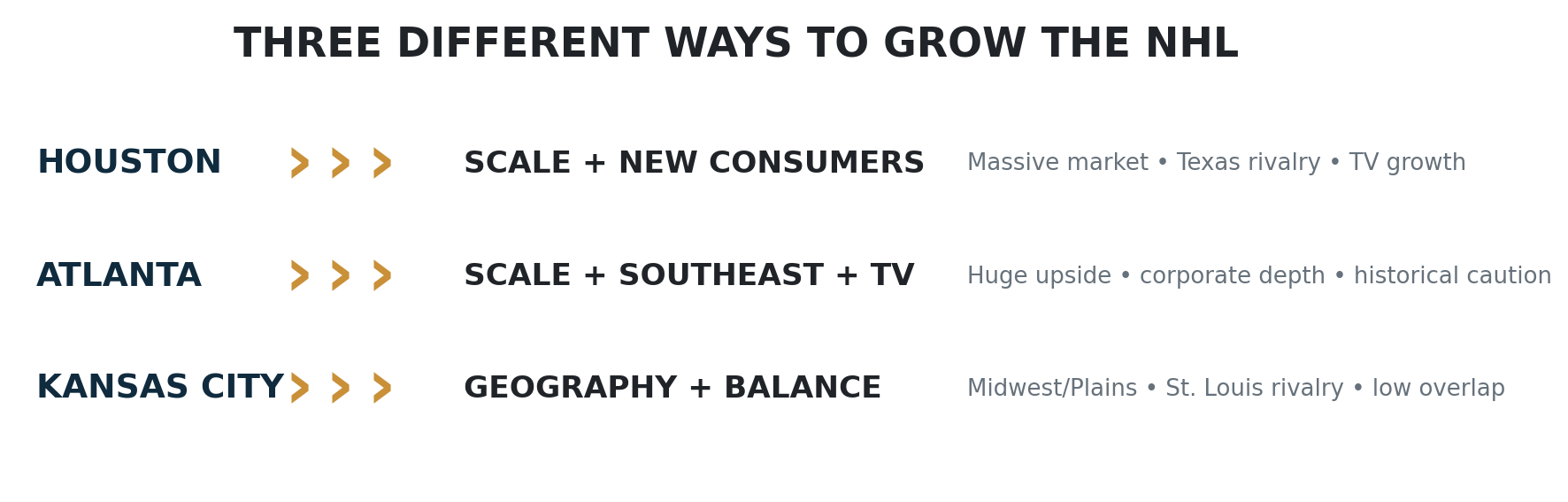
Houston remains the benchmark, but not because it has the best hockey culture. It doesn't. Its advantage is the enormous economic ecosystem surrounding a potential franchise. The Texans, Astros, Rockets and Dynamo demonstrate an established appetite for major professional sports, while the city offers the corporate base, premium-seat customers, media infrastructure and population associated with a major-league market. Houston also has professional hockey history through the Aeros. In a state whose major markets already command enormous sports attention, a second NHL club also creates something the league values increasingly: another large U.S. television market with a local reason to care about hockey.
More importantly, Houston isn't merely an expansion rumour. The NHL and the Friedkin family are in a formal feasibility process examining Houston or Austin for a potential 33rd franchise. The league said in June that the contemplated investment could approach $3.5 billion, including the expansion fee and a new arena, and in September said that evaluation was still ongoing. That gives the Texas proposition something the other markets on this list currently lack: a prospective ownership group already engaged directly with the NHL.
Then there is Dallas. The Astros and Rangers, Rockets and Mavericks, and Texans and Cowboys already demonstrate the possibilities of intrastate competition. The NHL wouldn't have to manufacture a Houston-Dallas rivalry; it would simply put one on ice.
But Houston's biggest opportunity may exist below the NHL level. A franchise would enter a huge market where hockey still has room to create new fans, youth players, rinks, sponsors, television viewers and hockey families. Houston isn't simply a franchise opportunity. It's a market-and-league-growth opportunity.
Open this graphic at full size
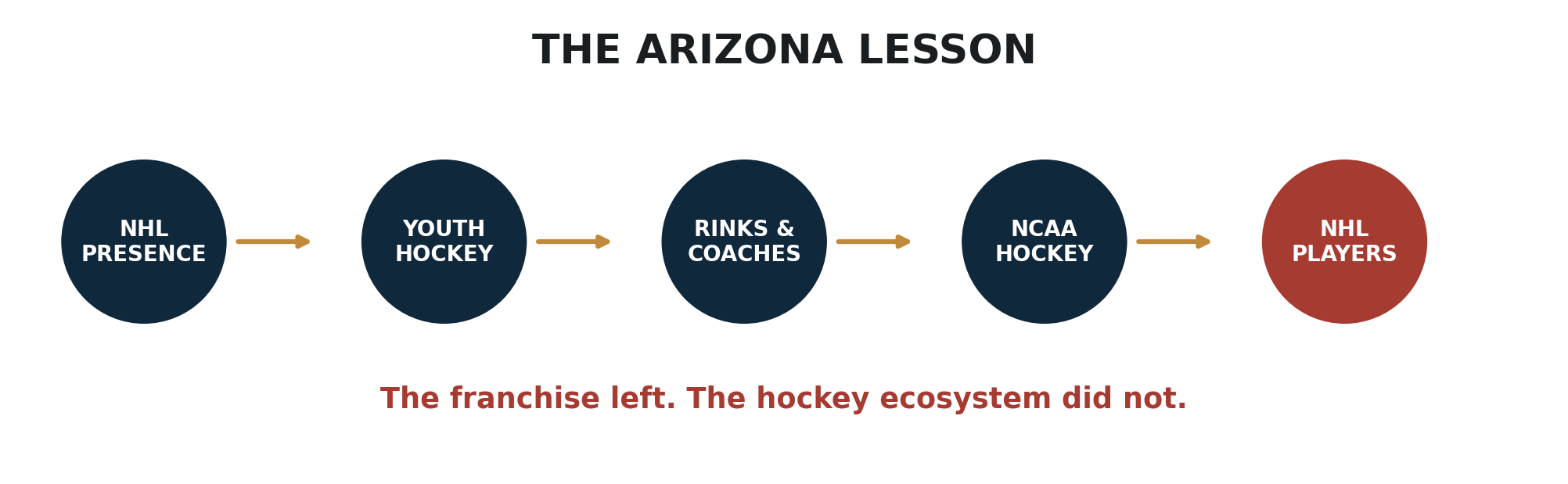
The Coyotes never established sustainable NHL business conditions, but their presence helped leave behind something larger than one franchise: an Arizona hockey ecosystem. Youth hockey grew, rink infrastructure expanded, Arizona State established NCAA Division I men's hockey, and players such as Auston Matthews and Matthew Knies emerged from the state.
We can't know the counterfactual. But Arizona raises a question worth carrying into every developing market: what does hockey look like there a generation after the NHL arrives? Expansion's legacy may be measured not only by whether the franchise survives, but by what the game becomes around it.
2. Atlanta — The Upside and the Warning
Atlanta can't escape its history. The Flames left for Calgary in 1980. The Thrashers left for Winnipeg in 2011. But saying “Atlanta failed twice” isn't analysis. The important question is why those franchises left and whether the conditions that contributed to those departures would still exist during a third attempt.
Atlanta remains an enormous corporate, media and television market with proven major-league sports capacity. Unlike Quebec or Hamilton, it also offers considerable room to create genuinely new NHL consumption across the American Southeast. But the Thrashers left only 15 years ago. A third attempt needs to demonstrate that the problems surrounding ownership, arena strategy, location and market development have actually changed.
Atlanta's potential is enormous. Its history simply raises the standard of evidence required to demonstrate that this time would be different.
3. Kansas City — Filling the NHL’s Middle
Yes, the Scouts failed. They joined the NHL in 1974 and relocated to Denver only two years later, becoming the Colorado Rockies. Six years later, the franchise moved again — this time to New Jersey — where it became the Devils. The same franchise that couldn't establish itself in Kansas City or Colorado eventually found stability in New Jersey and went on to win three Stanley Cups.
That history actually strengthens the point: sometimes the problem isn't the franchise itself. It's the combination of market, timing, ownership and circumstances surrounding it. Kansas City entered alongside Washington during an unstable period when the NHL was battling the WHA for players and expanding rapidly. Both clubs were terrible; one received the runway to survive and eventually flourish, while the other moved.
More than half a century later, the useful question is what Kansas City represents now. The Chiefs, Royals, Sporting Kansas City and KC Current demonstrate a deeply established professional-sports culture. The ECHL Mavericks provide an existing hockey foundation. Unlike several other candidates, Kansas City also occupies genuine space on the NHL map and would create an immediate rivalry with St. Louis.
Lamar Hunt Jr. owns the Mavericks and belongs to one of North America's most experienced sports-ownership families. There is no announced Hunt NHL bid, and this analysis shouldn't imply otherwise. But a market containing sophisticated sports-business infrastructure and ownership experience already invested in hockey has an advantage worth recognizing.
THIS IS NOT YOUR FATHER’S NHL — AND TODAY’S KANSAS CITY ISN’T THE KANSAS CITY THE SCOUTS LEFT BEHIND.
Open this graphic at full size
4. Quebec City — NHL Ready, But NHL Next?
Quebec may present the strongest counterargument to the first three markets because almost everything the NHL would have to build elsewhere already exists. There is hockey culture, an NHL-scale arena, history, identity and an immediate Montreal rivalry. The 18,000-plus-seat Videotron Centre is already operated by Quebecor, which controls arena management and naming rights through 2040 and has previously pursued an NHL franchise. Bring back the Nordiques and the NHL wouldn't have to teach a market to love hockey.
That makes Quebec extremely attractive from a franchise-risk perspective. The business case is more substantial than nostalgia alone: an NHL-ready building, an experienced media and entertainment company tied to the arena, strong junior-hockey attendance and a metropolitan region still growing toward one million residents. A Nordiques revival could create valuable ticket, premium-seat, sponsorship, merchandise, arena and local-media business. The complication isn't whether Quebec can generate hockey revenue. It is how much of that revenue would be new to the NHL rather than redirected from fans and sponsors already inside the league's Canadian economy.
That doesn't weaken Quebec's case. It defines it - and raises a question about timing. Perhaps Quebec isn't franchise No. 33 or 34. It may actually become more compelling at 35 or 36, after the NHL has first used expansion to establish itself in additional underserved American markets and, potentially, increased league-wide revenues and U.S. audience reach in the process.
There is a television thought experiment behind that argument. Imagine a future Vancouver-Quebec Stanley Cup Final. In Canada, it could be spectacular: two passionate markets, a national storyline and hockey history everywhere. In the United States, however, neither finalist would bring a local American market into the series. That does not make Quebec a bad NHL market - far from it. It asks whether, if the league has only a few expansion opportunities available, some of those opportunities should first be used to build more American markets with a direct stake in the NHL. Mass matters when the objective is to grow the game.
Quebec offers something the NHL may value even more at that later stage: certainty. After using expansion to pursue growth in less-developed hockey markets, the league could turn to a place where the arena, hockey culture, identity and rivalry are already waiting. Waiting carries a cost if expansion fees continue to rise, but it could also mean the Nordiques eventually re-enter a larger, richer league with a broader U.S. audience.
NHL-READY AND NHL-NEXT AREN’T NECESSARILY THE SAME THING.
The Middle of the Board
5. Orlando — Florida Isn’t an Experiment Anymore
The Lightning and Panthers have already answered whether major-league hockey can succeed in Florida. Orlando therefore isn't another Sun Belt experiment. It would test whether a third Florida franchise could create enough additional NHL consumption rather than redistribute parts of the Tampa Bay and Panthers audiences. The Solar Bears provide existing professional-hockey evidence, the Magic demonstrate major-league sports capacity and Tampa would provide an immediate rivalry.
6. Phoenix — The Franchise Left. Hockey Didn’t.
Phoenix now presents almost the inverse of its original expansion case. The NHL no longer needs to determine whether hockey can take root in Arizona; the Coyotes era already demonstrated that it can. The problem is the business infrastructure required to support an NHL franchise, particularly ownership and a credible long-term arena. Solve those issues and Phoenix becomes a very different proposition from the market the Coyotes originally entered in 1996.
7. Hamilton — Cannibalization or Hockey Cluster?
Hamilton might be one of the easiest markets in North America in which to sell hockey and one of the hardest to evaluate as expansion. Southern Ontario's demand is obvious, but many potential Hamilton customers are already Leafs or Sabres fans and already participate in the NHL economy. That creates legitimate cannibalization concerns, particularly for Buffalo.
But overlapping territories do not automatically make multiple franchises unworkable. The Rangers, Islanders and Devils operate within the greater New York metropolitan market, although New York's population and density make it an imperfect comparison. The more useful question is whether Toronto, Hamilton and Buffalo could function as a regional hockey ecosystem in which proximity creates more rivalries, travelling fans, media attention and overall NHL consumption. Cannibalization should be measured against the possibility that greater competition could make the regional NHL product more valuable.
8. Milwaukee — Traditional Hockey, New NHL Territory?
Milwaukee has perhaps the strongest traditional hockey foundation of the final three, with Wisconsin hockey culture, the Badgers and decades of Milwaukee Admirals history. A Blackhawks rivalry is obvious. Its challenge is determining how much genuinely new NHL territory exists within a region already influenced by Chicago and other established hockey markets.
9. Cleveland — Did Cleveland Ever Get a Fair NHL Test?
Cleveland deserves more consideration than the Barons' history suggests. The Barons were already a struggling franchise when they arrived from California, lasted only two seasons in Ohio and didn't actually play in Cleveland. Their home was the Richfield Coliseum in suburban Richfield, deliberately positioned between Cleveland and Akron. In theory that expanded the audience; in practice, the arena's distance from Cleveland, traffic and difficult access became disadvantages and hurt walk-up attendance.
It raises a legitimate question about how much the Barons' failure should really tell us about Cleveland as an NHL market. The team carried Cleveland's name while playing well outside the city's urban core, in an arena designed as much around access to Akron and the surrounding suburbs as Cleveland itself. A modern franchise would be fundamentally different: playing downtown in an established major-league sports district, with the AHL Monsters providing an existing hockey foundation and Columbus creating a natural in-state rivalry.
PERHAPS CLEVELAND NEVER REALLY RECEIVED A FAIR NHL TEST IN THE FIRST PLACE.
10. Cincinnati — Completing an Ohio Hockey Triangle?
Cincinnati extends the Ohio idea farther south. The Cyclones, Miami University hockey and the city's established major-league sports culture provide a foundation, while Columbus supplies the obvious opponent. Its most immediate obstacle is the arena. Put the three Ohio cities together and the question becomes whether another franchise would merely compete with Columbus or help create a stronger statewide hockey ecosystem.
Beyond the Top 10: Long Shots, But What the Heck
Swipe or scroll across to see all columns.
| MARKET | WHY IT INTRIGUES | WHAT HOLDS IT BACK |
|---|---|---|
| Saskatchewan | Province-wide hockey identity | Scale + arena |
| Halifax | Potential “Atlantic Canada’s Team” | NHL arena |
| Markham | Enormous GTA hockey market | Overlap + arena |
| Hartford | Hockey culture + Whalers identity | Crowded geography |
| San Diego | Large, relatively open market | Arena |
| Austin | Growth + current NHL evaluation | Houston comparison |
Saskatchewan shouldn't necessarily be evaluated as simply a Saskatoon metropolitan franchise; the Roughriders demonstrate the possibility of a province-wide sports identity. Halifax similarly would have to be evaluated as a potential Atlantic Canadian property rather than solely against Halifax's metropolitan population. Neither proposition eliminates the substantial arena and economic questions, but conventional metro population isn't the only way to define a sports market.
Past Failure Is a Variable, Not a Verdict
Open this graphic at full size
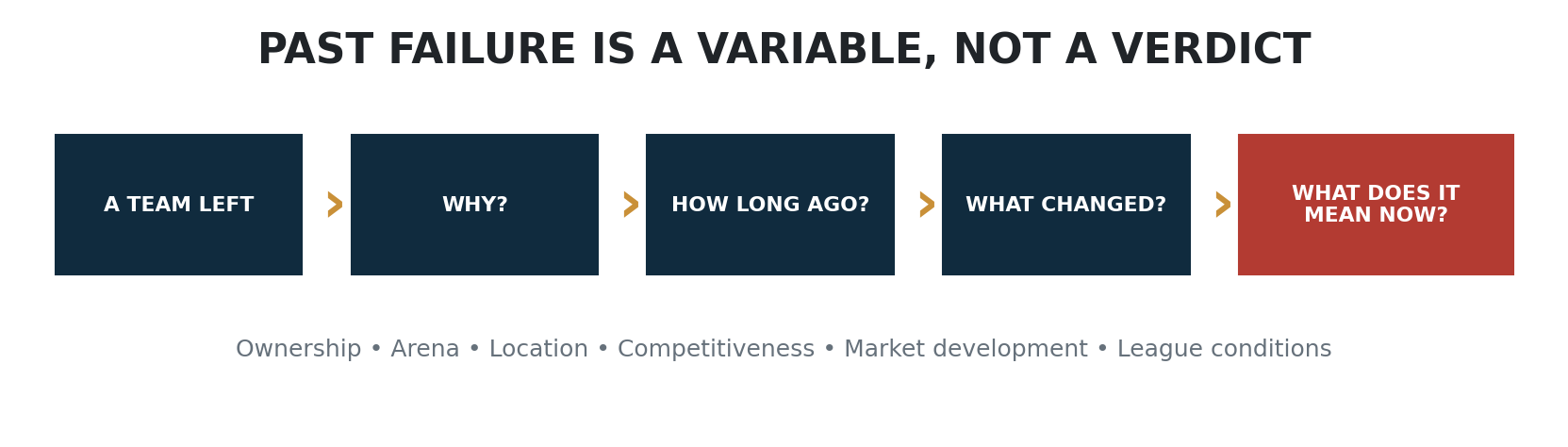
Atlanta lost two teams. Kansas City lost the Scouts. Cleveland lost the Barons. Quebec lost the Nordiques. Hartford lost the Whalers. Phoenix lost the Coyotes. Those are facts. They aren't conclusions.
A previous franchise's departure should increase scrutiny, but the weight assigned to it should depend upon why the team left, how recently it happened and whether those underlying conditions still exist. Kansas City's two-season experiment beginning in 1974 shouldn't carry the same cautionary weight as Atlanta losing the Thrashers in 2011. Cleveland's experience with a relocated team playing well outside downtown shouldn't automatically describe modern Cleveland. Quebec now possesses the NHL-scale arena it lacked when the Nordiques departed. Phoenix possesses a hockey ecosystem that barely existed when the Coyotes arrived.
Past franchise performance is a lag metric. Understanding why it happened reveals the lead indicators.
The Mass Audience Test
There is another reason to think about expansion as more than a collection of individual franchise decisions: exposure. Hockey keeps producing evidence that, when it is placed on a broad national stage and given genuine stakes, Americans will watch in mass numbers.
The 2025 4 Nations Face-Off championship between Canada and the United States drew 9.3 million U.S. viewers. At the 2026 Olympics, the U.S.-Canada men's gold-medal game averaged 18.6 million live viewers on NBC and Peacock and peaked at 26 million for the winning goal. Even the U.S.-Sweden quarterfinal averaged 6.9 million. Those aren't niche-sport numbers. They are evidence of what hockey can look like when the event, distribution and story are big enough.
The lesson may be that hockey's American challenge isn't simply convincing people that the sport is worth watching. It is giving enough people a reason - and an opportunity - to watch it. The NFL, NBA and MLB begin with enormous domestic footprints and constant local exposure. The NHL is still building that footprint.
That is where expansion becomes part of a media strategy. Put a team in Houston or Atlanta and the value isn't confined to 18,000 people in an arena. Another major U.S. market now has a home team, local coverage, sponsors, youth players and casual sports fans with a reason to care about the NHL. Do that successfully in enough places and hockey's ceiling in the American sports hierarchy becomes a more interesting question.
Hockey may sit fourth among the major North American team sports today. The 4 Nations and Olympics suggest the game itself can command a mass audience. More exposure creates more familiarity. More local markets create more reasons to watch. Fourth doesn't have to be treated as a permanent destination.
Swipe or scroll across to see all columns.
| Event / audience measure | U.S. audience |
|---|---|
| U.S. viewers 2025 4 Nations final | 9.3M |
| live U.S. viewers 2026 Olympic gold game | 18.6M |
| peak U.S. audience Olympic winning goal | 26.0M |
So Where Should the NHL Go Next?
Houston establishes the benchmark because it combines enormous economic scale, relatively little NHL cannibalization, the potential to create new consumers and league revenue, a natural Dallas rivalry and — uniquely among these markets — a prospective ownership group already engaged with the NHL in a formal feasibility process.
Atlanta and Kansas City are compelling counterpoints. Atlanta offers enormous scale and southeastern growth potential accompanied by relatively recent historical risk. Kansas City offers less scale but an unusually balanced proposition: existing hockey, strong sports culture, geographic value, comparatively little cannibalization and a natural St. Louis rivalry. Quebec offers something different again: hockey certainty.
When I look at NHL expansion, my heart and my head don't necessarily take me to the same place. My heart says put the next team somewhere hockey is already woven into the community — where generations have grown up with the game, where people have waited years for another chance and where an NHL franchise would be embraced from the moment the puck drops.
My head keeps pulling me somewhere else. It says take the game somewhere it can create something that doesn't exist today. Introduce millions of people to hockey. Build new fans, new players, new rinks, new television viewers and new hockey families. Grow league revenues. Build mass. Make the NHL stronger. And perhaps, a generation from now, create another place where hockey has become every bit as important as it is in the traditional markets today.
That's my alignment. Someone else might look at exactly the same evidence and place greater value on rewarding an established hockey market. Neither perspective makes the underlying facts different. It changes what we believe expansion should accomplish.
BEFORE CHOOSING THE CITY, DECIDE WHAT YOU WANT EXPANSION TO CREATE.
My heart may say Quebec.
My head says grow the game.
Hold Fast. Think Sharp. See the Game Clearly.