
This is not a ranking of the ten best sporting events I have ever attended. I am not sure I could make that list even if I tried. Over the years there have been countless hockey games — NHL, AHL, international tournaments and Memorial Cups — along with basketball games, NFL games, Major League Baseball and spring training, and even a few NASCAR events scattered across North America. My wife Angela has been beside me for more of them than I could count, including at least one NASCAR race that she attended considerably less enthusiastically than I did.
These are simply some of the events that stayed with me. Some were historically significant. Some involved famous athletes. Others would mean very little to anyone who was not there. That may be the point. A sporting life is not necessarily built from the biggest games. It is accumulated through the people who sat beside you, the places you travelled, the things you noticed that television could never show, the souvenirs that somehow survived, and the moments whose importance only became clear years later.
I have seen Wayne Gretzky and Mark Messier during the Edmonton Oilers dynasty years, Nolan Ryan pitch, Sidney Crosby several times — including once before most of the hockey world knew him — Connor Bedard score one of the great World Junior goals, and elite teenage prospects preparing for careers that may eventually take them to the NHL. I have visited some historic and iconic sporting venues across North America. Yet when I think back, I also remember getting lost on the way to a ballpark, a friend with tears in his eyes, a brother who could not find his seat, a baseball tossed toward me at Fenway Park, and a group of 12- and 13-year-old girls realizing they were provincial champions.
The official record can tell us the score, who scored and how many people attended. Memory has a different job. Memory decides what mattered.
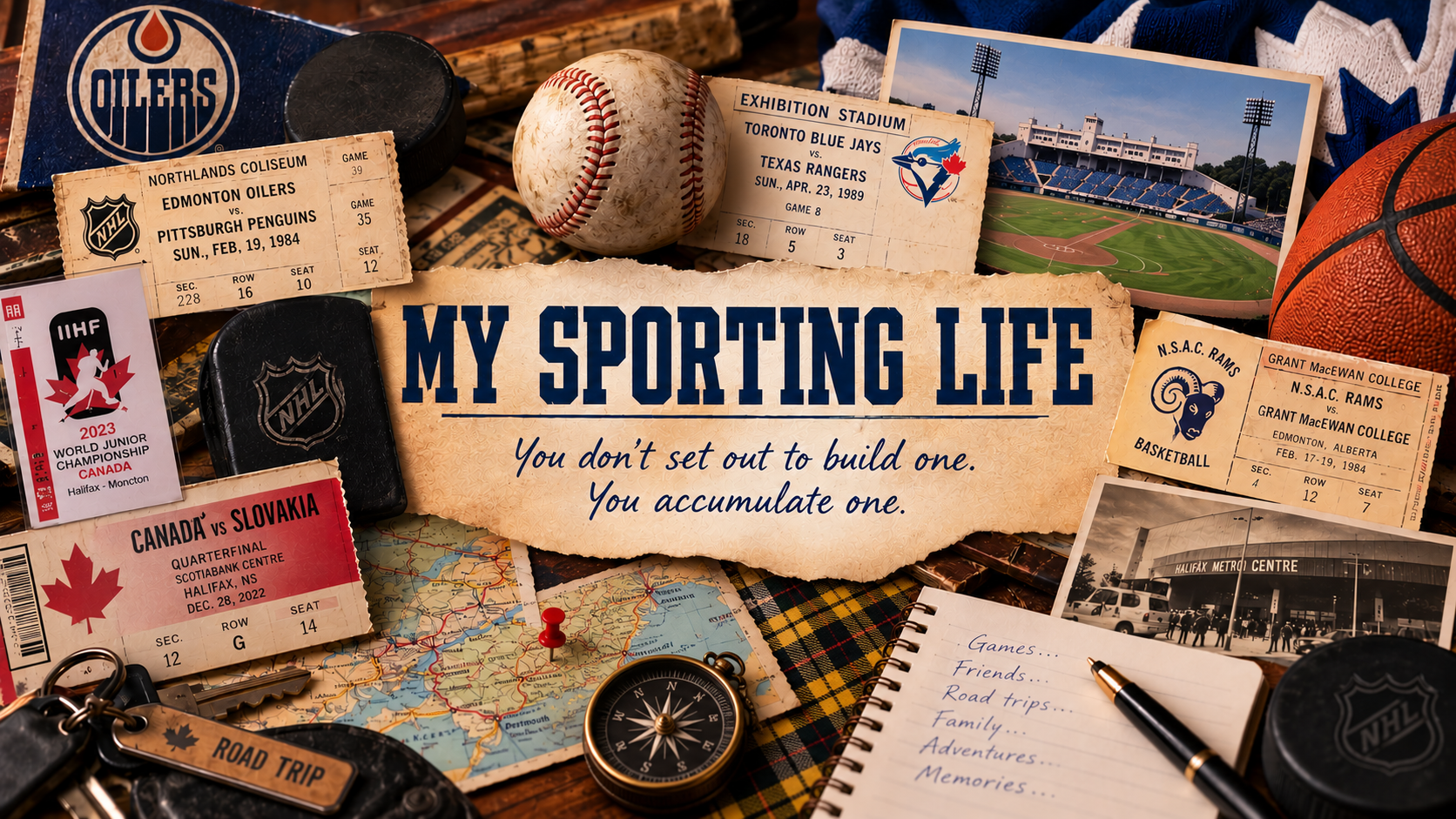
You don’t set out to build a sporting life. You accumulate one.
Edmonton, 1984: I Can’t Believe I’m Here
My first NHL game was not supposed to be some great hockey pilgrimage. I was 20 years old and playing basketball for the NSAC (Nova Scotia Agricultural College) Rams. We were in Edmonton on an exchange with Grant MacEwan Community College involving the men’s and women’s basketball teams, and on February 19, 1984, we went to Northlands Coliseum to see Pittsburgh play the Oilers.
Our tickets were in the nosebleeds, but this was a different era. We scattered around the building looking for open seats. Some people in our group found better ones and eventually got bumped. My friend Paul and I found seats at one end close to the glass and managed to stay there. Paul and I had been high-school teammates, played college basketball together and remained close long after those days. More than four decades later, we live in the same town and still hang out.
Edmonton won 7–3, and the box score now tells me I witnessed Gretzky, Messier, Glenn Anderson and Paul Coffey each record three points. I do not remember the goals. I remember the Oilers skating toward our end, seeing players I had only known from television suddenly become real, and being convinced for a moment that Mark Messier was looking directly at me.
Did he? Almost certainly not. Forty-plus years later, I do not particularly care. What mattered was the disbelief of a 20-year-old kid from Nova Scotia sitting in an NHL arena for the first time: I am actually here.
The official record remembers seven Edmonton goals. I remember Messier looking at me. That may have been my first lesson that the record tells you what happened; memory decides what mattered.
Toronto, 1989: “Better Than Behind Home Plate?”
Five years later I was on my first business trip to Toronto for a food show and, naturally, staying at the Delta Chelsea. Discount airfares often required a Saturday-night stay in those days, so I arrived before my co-worker and found myself alone in Toronto on Sunday, April 23. I decided to go to a Blue Jays game.
There was one problem: I was not entirely sure how to get to Exhibition Stadium. Think country mouse in the big city, long before a smartphone could tell me where to turn. I asked a hot-dog vendor for directions because I thought he looked like someone who could help me. There was one problem with my assumption: he did not speak much English. So on I trekked until I eventually found the park.
At the ticket booth I asked for a good seat. The seller suggested one behind home plate. Apparently I was not immediately satisfied and asked whether that was the best seat he had. His response has stayed with me: “Better than behind home plate???” Fair point.
So there I sat, alone, behind home plate for my first Major League Baseball game and only the second major professional sporting event I had ever attended. Nolan Ryan was pitching for Texas and pitched a gem. I wish I could say I spent the afternoon contemplating the historical significance of watching one of baseball’s great pitchers. I did not. I was too busy being amazed that I was sitting behind home plate at a Major League game.
The Blue Jays would move into SkyDome only weeks later. Exhibition Stadium was nearing the end of its run as their home, and Nolan Ryan was on the mound. Those details make the day more remarkable in retrospect. At the time, the feeling was much simpler: Life is good.
Maple Leaf Gardens, 1993: What Television Couldn’t Show
By April 1993 I was back in Toronto, possibly for the same food show. My boss had supplier connections, and those connections produced tickets to Game 3 of the Leafs’ playoff series against Detroit. Toronto had lost the first two games. Our seats were in the reds, around centre ice and definitely between the blue lines.
The first thing I remember is the electricity inside Maple Leaf Gardens. Toronto won, and because we got caught up in the excitement, my boss somehow found tickets for Game 4 and we went back and did it all again. I mean, we had to go, right? But the lasting lesson was not simply that playoff hockey was loud. It was how different NHL players looked when I could choose where to look instead of following a television camera.
The size, pace and skill were startling. I particularly remember Bob Probert. Everyone knew his reputation for toughness, but in person I could see his value as a hockey player and, perhaps more tellingly, how conscious the Leafs were of where he was. The box score can tell me he did not record a point in either game I attended. My memory tells me he mattered.
Television shows you the play. Being in the building lets you watch the game. I also bought two Leafs shirts during that series, probably the first meaningful pieces of what would become my sports memorabilia collection. More than three decades later, I still own them and still wear them. At some point a souvenir stops being a shirt and becomes an artifact.
New Glasgow, 2002: I Had to See What This Crosby Kid Was All About
By the early 2000s people in Nova Scotia hockey circles were talking about an underage kid from Cole Harbour named Sidney Crosby. He was playing against older boys with the Dartmouth Subways and the comparisons were already absurd: the next Gretzky? I had to see what this kid was all about.
Dartmouth had to get through the Weeks Triple A Midgets, and a playoff game at the John Brother MacDonald Stadium in New Glasgow gave me the chance to see Sid the (actual) Kid. I remember a high-scoring game, somewhere around 8–5, and Crosby being involved in more than half of Dartmouth’s offence. I would describe those details as memory rather than official statistics. What I know is that he dominated and somehow made it look effortless against players who were bigger and older. One goal from just inside the blue line remains particularly clear.
There was also something wonderfully local about it. I had crossed Canada to see Gretzky. Now a Nova Scotia kid carrying impossible expectations was showing flashes of greatness in New Glasgow. Sometimes you stumble into greatness without knowing what you are seeing. This time I went looking for it, wanting to know whether the stories were true. They were.
Denver, 2005: Sometimes the Game Is Bigger Than the Game
In October 2005 I was travelling in Western Canada for work when the wife of my close friend Mark called. She wanted to give him a special gift: a trip to Denver to see his favourite team, the Broncos. Would I meet him there? That decision did not take long.
Mark and I had already accumulated enough sporting trips together that choosing only Denver for this story feels a little unfair. Two others deserve at least honourable mention.
In March 1993, Mark and I travelled through Florida with our friends Barry and Robert on what, looking back, was an early version of the sporting road trips I still love. The Blue Jays were in spring training, preparing to defend their World Series championship, and we packed an almost ridiculous amount of sport into one vacation. We saw two Jays games and a Red Sox game. On March 20 we went to Expo Hall, the makeshift home of the Tampa Bay Lightning in their inaugural season, and watched Buffalo’s Alexander Mogilny score his 70th and 71st goals of the season. He would finish with 76, tied with Teemu Selänne for the NHL lead — so what seemed like another game on a Florida vacation became a small piece of hockey history we happened to witness.
Three days later we were in Orlando watching another young star at the beginning of something special. Rookie Shaquille O’Neal had 28 points and 10 rebounds as the Magic beat Miami. Somewhere around all of that were Isla del Sol Villa, four friends roaming Florida in what I remember as a Lincoln Town Car, too many omelettes, too many well drinks and probably too much sun. Loads of fun.
Five years later the same four of us tried another sports-and-entertainment trip, this time to Montreal. The plan was Canadiens–Rangers and a Rolling Stones concert. The timing was spectacularly bad. We landed in the middle of the January 1998 ice storm, and neither event survived it. By the time the cancellations came, we were already there. So instead of hockey and the Stones, we sat in the hotel, had a few drinks and reminisced about previous road trips and ball tournaments. Even the trip where we saw neither of the things we travelled to see became part of the story.
That history is part of why Denver belongs here.
I met Mark at the airport and almost immediately we saw Eagles fans descending on Denver. They were everywhere — at the airport, in the bars and throughout the city. As an added bonus, we watched the Colorado Avalanche play the Vancouver Canucks on Saturday night — hey, this was probably a Hockey Night in Canada game — and then immersed ourselves in football on Sunday: tailgating, outdoor events, a little rain, a bit of chill and, somehow, a charity haircut for me. None of the weather mattered.
Our seats were only a few rows behind the Broncos bench. I looked at Mark and saw tears in his eyes. That is one of the images I remember most. Then there was Terrell Owens. Everyone knew he was fast, but television had never shown me how fast. In person, the football field seemed to shrink around him. When he caught a pass and went 91 yards for a touchdown, the speed was astonishing. Only later did I learn that this was his final game as a Philadelphia Eagle. Icing on the cake: the Broncos won soundly.
But Denver belongs in this story less because of Owens than because of Mark. Florida had been about four friends cramming as much sport and fun as possible into a vacation. Montreal became memorable despite the fact that we never saw either event we travelled there to see. Denver was different again. I was watching a friend experience something that genuinely meant something to him.
I had already attended NHL games and Major League Baseball. Now I was beginning to understand that sometimes the best part of a sporting event is watching what it means to the person beside you.
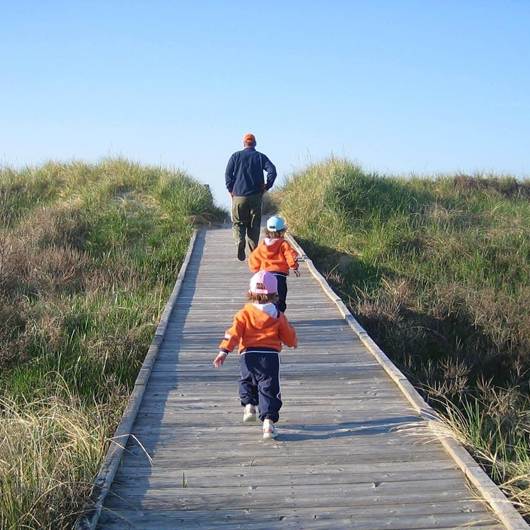
I brought Broncos clothing home for myself and my daughters. Years later those little outfits appeared in one of our family’s favourite photographs, the girls following behind me along a boardwalk in Broncos orange. We still have the girls’ outfits. The football game ended in 2005; its fingerprints on our family did not.
Toronto, 2022: Glenn’s First NHL Game
My brother Glenn was approaching 60 and had never attended an NHL game. He had also never been on a commercial flight. That seemed like two problems I could solve at once, so I arranged a trip to Toronto for Bruins–Leafs.
Glenn is as gregarious as they come. He sat behind me on the plane and I could hear him talking with his row mates practically all the way to Toronto. At the arena, every Boston jersey was an invitation to strike up another kindred-spirit conversation. While we waited in line, I was invited to take part in a YouTube trivia video. The question: who was the first European captain of an NHL team? Mats Sundin. Correct. The prize: an autographed Doug Gilmour jersey. Sporting memories sometimes just fall into your lap.
Inside we had great red seats near the blue line opposite the benches. Glenn went wandering and, about ten minutes later, called me: “I can’t find our seats.” The best part was that I could see him about six rows below me. I began thinking I might need a harness.
Once safely returned, Glenn sat one seat in from the aisle beside Leafs fans who, naturally, became his newest best friends. They laughed and chirped one another all night, and the Leafs fan beside him eventually wanted a photograph together. Opposing jerseys, same picture. The Leafs won, which suited me, but the score is not why the night belongs here.
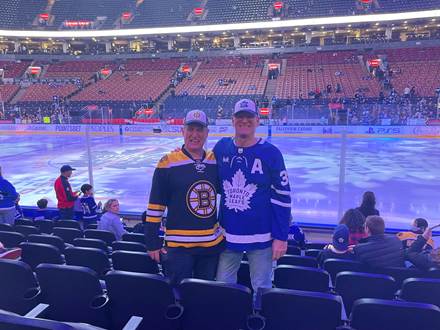
In Edmonton in 1984, I had been the person overwhelmed by my first NHL game. Thirty-eight years later I got to sit beside my brother while he experienced his. At some point, accumulating a sporting life stops being entirely about finding new experiences for yourself. Sometimes you get to give somebody else their first.
Halifax, 2022–23: Heave Away, Me Jolly Boys
The 2023 World Junior Championship was different because it was not one game. It became part of a Christmas memory. My employer had four tickets to the Halifax games for employees to entertain clients. My co-workers had young children and were not particularly big hockey fans. I faced no such lack of enthusiasm, and suddenly I had access to every Team Canada game I wanted.
On Boxing Day Angela and I took a client couple to Canada–Czechia. Canada lost 5–2, and I left wondering what version of Team Canada had shown up. I missed December 28, returned on the 29th and attended every Canadian game thereafter. Angela joined me for several, as did clients and friends. We had such a great time that when Pittsburgh came to Halifax for an exhibition game in October 2023, we made that another couples’ night.
Halifax did what Maritime hockey towns do. The building filled, the crowd found its characters — even an on-ice camera operator seemed to develop a following — and The Fables’ “Heave Away” became part of the soundtrack. It was more than a series of hockey games. For nearly two weeks, the tournament became a shared community experience, something discussed over dinners, at work and on the way into the arena.
That feeling of connection led to one of the most meaningful moments of the tournament. Börje Salming had died only weeks earlier. As a Leafs fan, he had meant a great deal to me, and when the Leafs offered commemorative jerseys and Salming patches, I could not resist. I bought a jersey and a couple of patches, with the patches sold in support of ALS. Before the Sweden game, I decided the extras might mean even more to Swedish players than they did sitting in my Leafs room.
During the game I walked across to the Swedish supporters and asked who among them was the parent of a Swedish defenceman. Eventually I was directed to the father and grandfather of Axel Sandin-Pellikka who now plays for the Detroit Red Wings. I explained the Salming connection and asked that the patches make their way to the players. I had enjoyed owning them. I enjoyed giving them away more. For a few minutes, a Leafs fan from Nova Scotia and a Swedish hockey family were connected by a player who had meant something to both countries.
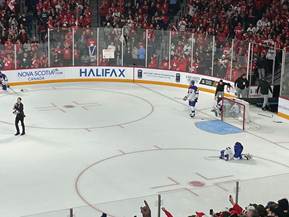
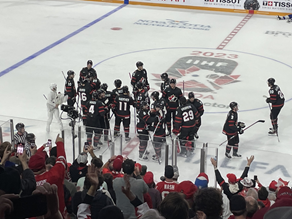
The 2023 World Juniors in Halifax became much more than a single game.
Then came the quarterfinal against Slovakia. Our seats were about 12 rows back near the blue line, at the end where the winning goal would eventually be scored. Canada led, Slovakia kept coming, and eventually the game reached overtime tied 3–3. The building had changed. This was no longer simply another night at the World Juniors; Canada’s tournament could end with the next mistake.
Connor Bedard got the puck, danced through the Slovaks and scored at our end. The arena exploded. One of my photographs afterward shows Slovak players still on the ice in disbelief while the Canadians celebrate elsewhere. I love that photograph because it captures both sides of sport. One moment can become one person’s treasured memory and another person’s heartbreak. I had witnessed one of Canada’s great international hockey goals, a moment that, for me, belongs in the same conversation as the goals we still remember from Henderson, Sittler, Lemieux, Eberle and Crosby.
Canada beat the United States in the semifinal and then faced Czechia again for gold. Canada led 2–0 late in the third before Czechia scored twice in 54 seconds. Back to overtime. Six minutes in, Dylan Guenther scored from Joshua Roy and Brandt Clarke. Canada had gold. A man behind me celebrated by distributing what seemed to be an entire glass of beer over everyone in front of him. Normally, this guy would have annoyed me. That night, somehow, the beer shower became another great piece of the experience. And somewhere in all the noise was ‘Heave Away’ again.
I had bought a Bedard jersey after the first game and wore it to every Canadian game thereafter. I remain open to the possibility that this was the tactical adjustment Team Canada needed.
The World Juniors belongs here not simply because I saw Bedard’s goal or a gold-medal overtime winner. It showed how sport creates temporary communities. Angela, friends, clients, strangers in Swedish jerseys, thousands of Maritimers and young players from around the world became part of the same story for a few days. Most of us would never meet again, but for that Christmas we shared the same building, the same tension and, eventually, the same song. Heck, we even shared a beer — whether everyone in front of that fellow wanted to or not.
Fenway, 2024: I Got the Baseball
In August 2024 Angela and I took a road trip to Boston. The arrangement was reasonably balanced: Boston sightseeing and a Red Sox game for me, a Kenny Chesney concert in Bangor for Angela on the way home. We even watched a Patriots practice the day before the game. Fenway, though, was a bucket-list destination for me.
Thirty-five years earlier I had wandered around Toronto looking for Exhibition Stadium and then sat behind home plate, too overwhelmed by my first Major League game to fully appreciate Nolan Ryan. By 2024 I understood exactly why I wanted to see Fenway. I wanted the Green Monster, the old advertisements — the W.B. Mason signs stand out in my mind as if they have always been there — the odd dimensions and the character of the oldest Major League ballpark. I wanted to see whether a place I had watched on television for decades felt different in person. It did.
We sat six rows behind the Red Sox dugout. Kutter Crawford was perfect through five innings, and suddenly a bucket-list visit carried the possibility of something historic. Then Boston exploded for five runs in the bottom of the fifth. Crawford sat for a long time, and I remember wondering whether the delay might cool him off. In the sixth, the perfect game disappeared, followed by the no-hitter and the shutout.
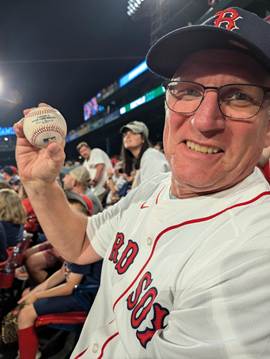
But the night had another memory waiting for me. At the middle of the seventh, after the third out, Rafael Devers tossed the ball toward the seats as he returned to the dugout. It was coming my way. Years of playing first base suddenly had a practical application, and none of the younger guys around me were taking that baseball. I caught it.
There is a photograph of me moments later holding it up and smiling like a kid. That photograph may explain Fenway better than any box score. At 25, I had attended my first Major League game alone and simply marvelled that I was there. At 60, I deliberately returned to baseball history with my wife beside me — and this time the game literally handed me something to take home.
Most sporting memories cannot be held. That one can. The baseball now connects the boy who played first base, the young businessman who once got lost trying to find Exhibition Stadium, and the older fan who finally made it to Fenway. That is how a sporting life accumulates: sometimes decades apart, the pieces unexpectedly find one another.
Toronto, November 2024: Four MacLeods, Two Teams
A few months later my younger brother Gary and his two sons joined me for Leafs–Canadiens in Toronto. The loyalties divided neatly. Gary and his youngest, Connor, are Canadiens fans. Connor MacLeod — yes, Connor MacLeod. As far as we know, not the immortal Highlander. Jordan, Gary’s oldest, and I — being of sound mind — are Leafs fans.
Before the trip I learned that Gary had attended his first NHL game only within the previous year. This would be Jordan’s first. So we made a weekend of it: the Chelsea, Real Sports, the Hockey Hall of Fame, where we happened to see David Poile during his Hall of Fame induction weekend, and then Real Sports again before the game.
When we reached our seats, I discovered that we were in seats 3, 4, 5 and 6 of the exact row where Glenn and I had occupied seats 1 and 2 two years earlier. You cannot make that up. Fortunately, Gary and the boys found their seats without incident. No harnesses were required.
There was plenty of Leafs–Habs banter, souvenirs were purchased, and I added a Matthew Knies jersey to a collection that has somehow grown to around 70. Toronto won 4–1, which Jordan and I considered an acceptable outcome. During the pregame spectacle giant Leafs and Canadiens flags passed over our section. Some of our photographs are little more than fields of red or blue because we were underneath them. They are imperfect photographs, but that is why I like them. A professional image shows what the flags looked like. Ours show what it felt like to be under them.
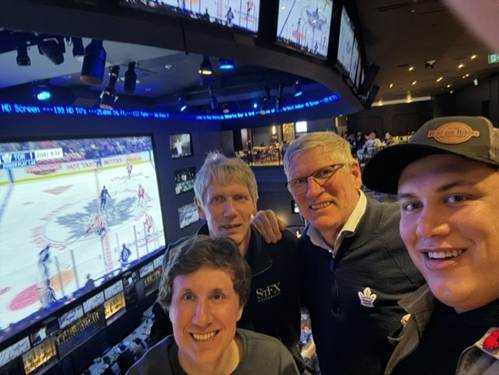
Four MacLeods, two teams: Leafs–Canadiens weekend in Toronto.
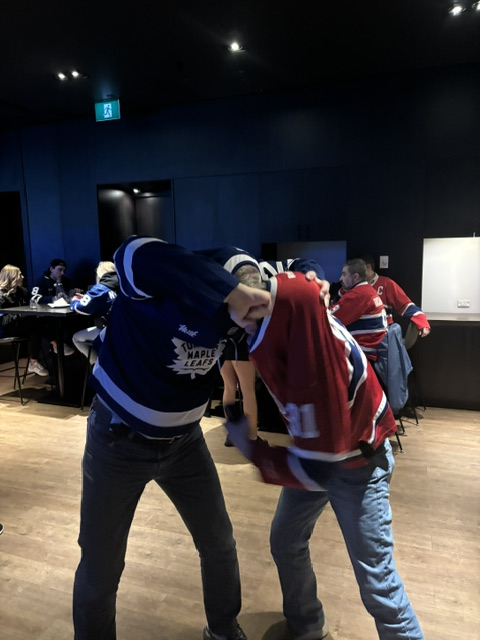
A weekend built around more than the game itself.
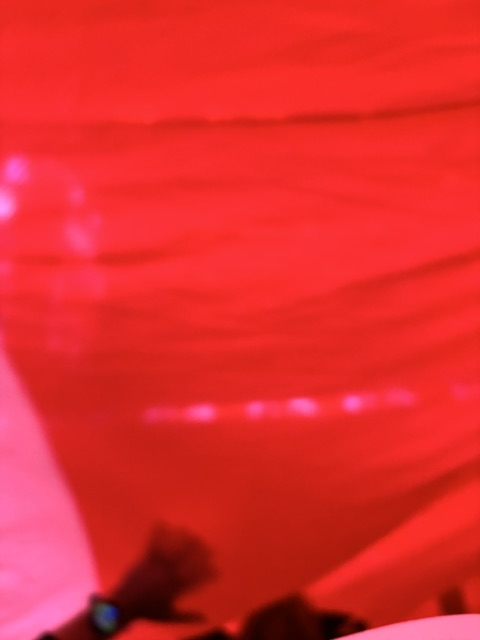
Under the colours during Leafs–Canadiens.
Sunday we finished at the Sport Card & Memorabilia Expo, wandering the International Centre and buying a few cards. By this point I had learned something that the 20-year-old in Edmonton did not yet understand: the game does not have to be the whole event. Take the trip. Bring your brother and his sons. Eat together. Chirp one another. Buy something you probably do not need. Go to the Hall of Fame. Go to the card show. Take ridiculous photographs.
Years later, nobody is going to remember what the tickets cost. They are going to remember the weekend.
Truro, 2025: I Was a Czechian for a Week
Angela and I moved to Truro in May 2025. Our two youngest daughters were on their own, we were downsizing, and I had retired — or so I thought. I subsequently accepted a one-year contract with my former employer, mostly working from home. Then the Eastlink Centre announced it would host the World Under-17 Hockey Challenge and needed volunteers.
This was exactly the sort of thing I had retired so I would have time to do. Minor complication: I had gone back to work. I applied anyway and eventually received the email: Team Host — Czechia. My first reaction was, “Aw, I was hoping for Canada.” To borrow from Garth Brooks, sometimes I thank God for unanswered prayers. I took a week of vacation.
My co-host and I met the Czech team at Halifax airport, and from there our role was essentially to solve whatever local problem arose. A star player broke a shin pad? I was outside Sports Experts waiting for the doors to open. A skate needed repair? Find someone. The glove dryer needed a fuse? Find a fuse. Towels were short? Find towels. Their hallway needed more privacy? Fix it. Equipment had to get to Amherst? I drove the van. Need someone on the gate? Apparently I was that guy too. Big man on campus.
Then the coaches needed their white shirts cleaned before a televised game. I was not putting them in a washer with the players’ equipment — or, as I learned that week, their “gitch.” I took the shirts home, washed them, dried them, steamed them and returned them on hangers in plastic. None of these jobs was glamorous. That was precisely why they mattered. I wanted the visitors to leave believing that Nova Scotia had looked after them.
What came back to me was more than I expected: Czech team gear, an autographed stick from a high-level prospect, two autographed jerseys I will keep forever, a continuing friendship with the equipment manager and a behind-the-scenes view of an elite hockey program. More important was the way the players treated me. These were focused young athletes playing in front of scouts, yet they were respectful and grounded. They made me feel as if I had been part of their team for years.
My mother’s birthday occurred during the tournament, and the players helped make a video for me to send her. I even met Gary Roberts, but oddly enough the famous former NHL player feels almost like a footnote. The players, staff and experience are what I remember. I also wonder whether the hospitality we showed those young men might stay with them — and perhaps someday be paid forward to someone else.
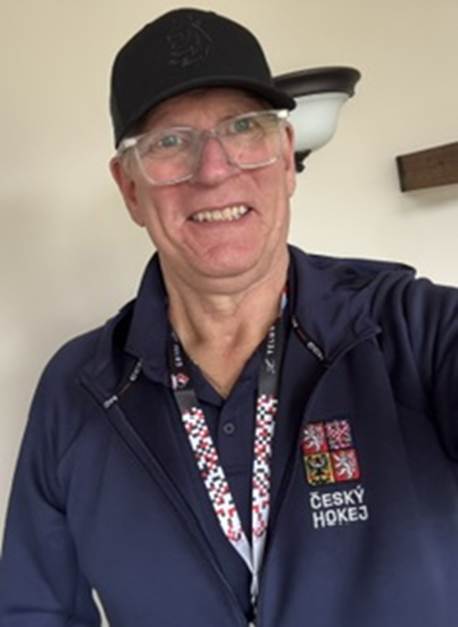
For one week in Truro, Team Czechia became my team.
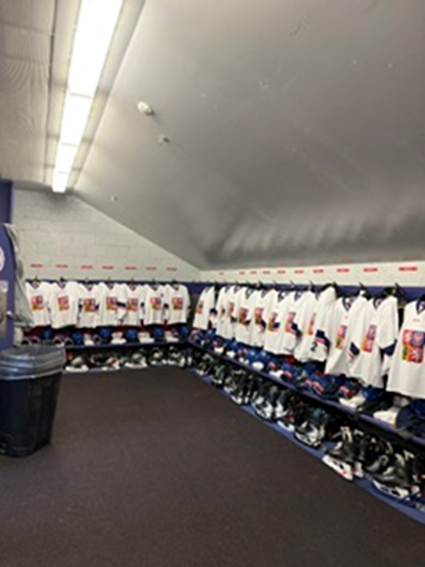
Behind the scenes at the 2025 World Under-17 Hockey Challenge.
Some of the keepsakes from a week that became much more than a volunteer assignment.
For one week, I was a Czechian, and I loved every minute of it. At the end I wondered when I might get to do it again. I may already have the answer. The Czech equipment manager and I have remained in touch, and he wanted me to come to Oakville this November to assist the team again. We tried to work out the logistics but alas it was not to be.
This time there is one important difference: I am retired for good. If we can make it work, I will be there. Apparently once you have been a Czechian for a week, it is difficult to give it up.
There is a nice symmetry in that. At 20 I sat in Northlands Coliseum unable to believe I was close enough to watch NHL players skate toward me. Four decades later I was carrying equipment, solving problems, opening gates and sharing hallways with teenagers who may someday become NHL players themselves. Somewhere along the way I had moved from simply attending sporting events to becoming, however briefly, part of one.
And One More...
If this were simply a list of memorable games, the story could end in Truro. But there is one experience that does not fit neatly beside the others. I was not in the stands. There were no professional athletes, no historic stadium and no future Hall of Famer required. I was coaching 12 girls, including my youngest daughter Hannah.
It began years earlier when my fourth daughter, Haileigh, came home from Grade 4 and informed me that she had told the principal I might be a candidate to coach the elementary-school basketball team. Just like that, I was back in the coaching ranks. One team became two the next year — elementary and a Pictou County U12 girls club team — and then three teams. Along the way I met many of the girls I would eventually coach on the U14 team that went to provincials in Windsor, Nova Scotia, a town often referred to as the birthplace of hockey.
The philosophy was simple: teach fundamentals, help them understand the 2-on-2 and 3-on-3 games happening within five-on-five basketball, and make sure every player who might be needed late in the season was as prepared as she could be. We had to have fun. It was also okay to win as a by-product. I used to tell them we did not need to win every game; the goal was to win the last game we played. If the last game happened to be for a gold medal, even better.
Development sometimes meant deliberately putting them in uncomfortable situations. I took groups to basketball camps in Maine so they could see another level and understand what it would take to reach it. On one trip we were being outscored badly, and one mother asked whether I had expected it. Yes. Winning those games was not why we had come. Experience was. It was also about team bonding; we did plenty together beyond the court. Her daughter continued playing for me, so apparently I survived the explanation. And the trips were not all serious development: on one drive, a player taught me to speak whale like Dory in Finding Nemo.
The championship season did not begin with any declaration that this was our year. I was coaching my older daughter’s junior-high team and my youngest daughter, Hannah’s U14 team. The U14 girls built cohesion, had fun, played tournaments and finished second a few times. They were getting stronger. Then came Windsor, and we went undefeated.
Before the final we talked about nerves. Of course they were nervous. But the girls on the other side were probably nervous too. The answer was not to pretend the nerves did not exist. It was to play anyway. Our girls were focused, and the more experienced players on the team played with purpose.
Late in the championship game, with perhaps three or four minutes remaining, I realized we were going to win. Suddenly more than 50 years of my own sporting life came flooding back. I had played hockey, soccer, basketball, baseball, softball and slo-pitch. I had coached boys and girls. I had come close. I had finished second and third. I had never been a provincial champion.
It had taken me more than half a century to get there. These girls were 12 and 13 years old.
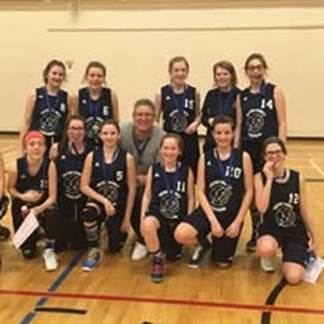
That was when a tear or two — or three — started. I was ready to blame it on some nearby onions, but I think they would have seen through that. For the final few minutes I stood quietly at the end of the bench. Anyone who knows me will understand that the word “quietly” is probably the clearest evidence that something unusual was happening. The game ended, the girls celebrated and eventually gathered back around the bench. Hannah noticed me first, looking a little puzzled before she smiled. I am sure the others noticed too.
The girls signed the championship banner, which went back to the club. I wanted something of my own, so I took a basketball and had all 12 players sign it. Today it sits front and centre in my man cave among the Leafs jerseys, cards and other pieces of a lifetime around sport.
But the basketball is not the ending.
Eight Years Later
I have watched those girls grow up. Some continued playing basketball into university or college. Others moved into careers in business, education, health care and whatever other directions they chose. Every once in a while I see one. Sometimes there is a smile. Sometimes a hug. Sometimes I get a message from a parent telling me how glad their daughter was to have me as part of her life. One parent even told me her daughter had written about me in a school assignment. There are those onions again.
Just last month Angela and I were at a social event when I recognized Jesse, one of those players. I tapped her on the shoulder. When she turned and realized who it was, she immediately handed off whatever she was carrying so she could give me one of the biggest hugs I have ever received. Actually, I got a couple.
Jesse is 22 now. She talked about those years, how much fun she had and how much she enjoyed playing. Then she told me I was the greatest coach ever.
Eight years earlier I thought the provincial championship was the measure of what we had accomplished. Maybe I was wrong. Jesse did not start with the championship game or a final score. She remembered having fun. That had been the objective from the beginning: teach them, challenge them, create experiences and make sure they enjoyed being there. If winning came along as a by-product, that was okay too. As Jesse pursues a career in education, perhaps some small part of what she experienced during those years will become part of the fabric of the teacher she becomes. I suspect she is already well on her way.
Looking back, the common thread is not really Gretzky, Ryan, Crosby, Bedard, Fenway Park or a gold medal. It is Paul beside me in Edmonton. Mark in Denver. Glenn meeting strangers in Toronto. Angela sharing more games and road trips than could ever fit in one article. Brothers and nephews divided by Leafs and Canadiens jerseys. Swedish strangers connected by Börje Salming. Czech teenagers making a birthday video for my mother. Twelve girls celebrating together in Windsor.
The jerseys, baseballs, signed sticks, photographs and basketballs are wonderful things to have. But they are really markers — physical reminders of the people and experiences attached to them.
Maybe that is the part of a sporting life I did not understand when I was 20 years old sitting in Northlands Coliseum. We accumulate these experiences, but we do not necessarily keep them to ourselves. Somebody creates an experience for us. Years later, we find ourselves creating one for somebody else.
Perhaps one of those Czech players will remember being looked after in Nova Scotia and someday do the same for someone else. Perhaps something one of those basketball players learned during our years together will find its way into a classroom, workplace, team or family. I may never know. Maybe that is all right.
Because I am beginning to think the real measure of a sporting life is not how many games you attended, famous athletes you saw or memorabilia you accumulated. It is the experiences you were given, the people you shared them with and, eventually, the experiences you helped create for somebody else.
You don’t set out to build a sporting life. You accumulate one. And, if you are fortunate, somewhere along the way you discover that you became part of somebody else’s too.
Jesse’s hug, eight years after that championship, was a pretty good reminder of that.
As for her assessment that I was the greatest coach ever?
Who am I to argue?