

In this report
There is one number every Toronto Maple Leafs fan knows: 1967. It has become shorthand for failure, a punchline and an opposing-fan chant. But perhaps we have heard it so often that we have lost sight of how extraordinary it really is.
On May 2, 1967, the Maple Leafs defeated the Montreal Canadiens and won the Stanley Cup. They have not played for one since. They have not lost a Stanley Cup Final, blown a lead in one or suffered a heartbreaking Game 7 with the Cup somewhere in the building. They simply have not been back.
Not once.
To properly judge what the Brendan Shanahan era accomplished — and what it failed to accomplish — we first have to understand the franchise he inherited. Because 1967 was not simply a long time ago. It was almost another NHL.
An Entire League Grew Up While Toronto Waited
When Toronto last lifted the Stanley Cup, the NHL had six teams. The following season, the league doubled in size. Since then, entire franchises have been conceived, awarded, built, failed, rebuilt, relocated and built again while Toronto has waited for another appearance in the Final.
Swipe or scroll across to see all columns.
| Expansion / franchise story | What happened before Toronto returned to the Final |
|---|---|
| 1967 expansion class | Philadelphia, Pittsburgh, St. Louis, Los Angeles, Minnesota and California entered; five of the six franchise lineages eventually won a Cup. |
| 1970-72: Buffalo, Vancouver, Islanders, Atlanta | Buffalo and Vancouver reached Finals; the Islanders won four straight Cups; Atlanta later moved to Calgary and won one. |
| 1974: Washington + Kansas City | Washington won in 2018. Kansas City moved to Colorado, then New Jersey; the Devils lineage won three Cups. |
| 1979 WHA arrivals | Edmonton became a dynasty; Quebec moved to Colorado and won multiple Cups; Hartford became Carolina and won championships. |
| 1991-93 expansion wave | San Jose, Ottawa, Tampa Bay, Florida and Anaheim arrived. Tampa Bay, Florida and Anaheim later won Cups; San Jose and Ottawa reached the Final. |
| 1998-2000 expansion wave | Nashville, Atlanta, Columbus and Minnesota arrived. Nashville reached the Final; Atlanta later relocated to Winnipeg. |
| Vegas - 2017 | Played its first NHL game 50 years after Toronto's last championship and won the Cup in its sixth season. |
STANLEY CUP FINAL APPEARANCES SINCE 1967: 0
That is not simply a championship drought. It is a return-to-the-championship drought. Even some of North American sports' most famous title-starved teams have returned to the championship stage. Phoenix entered the NBA in 1968 and has never won a title, but the Suns have reached the NBA Finals three times. Cleveland's baseball franchise has not won the World Series since 1948, yet it has returned multiple times. The NFL's Arizona Cardinals have an even older championship drought and still appeared in a Super Bowl.
Toronto's distinction is not merely that the Leafs have not won. Nearly six decades have passed without another opportunity to play for the championship: generations of players, expansion, the WHA merger, realignment, lockouts, the salary cap and analytics — and still no Final.
But There Is Another Side to the Cup Argument
Winning the Stanley Cup is extraordinarily difficult. That statement sometimes sounds like an excuse. It should not. It is mathematics. In today's 32-team NHL, if every team were equally likely to win, any one club would begin a season with just a 3.125 percent chance of becoming champion.
Even in an imaginary world of perfect parity, championships would not arrive on a tidy 32-year rotation. Under a simplistic equal-probability model, a team would still have about a 36 percent chance of going 32 seasons without winning once.
So the fact that a good team does not win the Stanley Cup is not, by itself, proof that the organization was poorly constructed. But Toronto's drought did not begin in a 32-team league; it began with six. League size helps explain why championships should never be treated as automatic. It does not explain away 1967.
If the Stanley Cup is the only measurement we are willing to use, we may learn almost nothing about whether an organization is moving closer to winning one. That requires looking at the process underneath the result.
The Leafs Weren't Always Bad. That Wasn't the Problem.
It would be easy - and inaccurate - to compress everything from 1967 to Shanahan's arrival in 2014 into one uninterrupted story of incompetence. Toronto had good teams, and some were excellent. The late-1970s Leafs featured Darryl Sittler, Borje Salming and Lanny McDonald. The Doug Gilmour-Pat Burns teams reached consecutive conference finals in 1993 and 1994, while the Mats Sundin-Pat Quinn Leafs produced another legitimate competitive window, including conference-final appearances in 1999 and 2002.
The 1993 run came agonizingly close. Toronto led Los Angeles three games to two and was one victory from its first Stanley Cup Final since 1967. In Game 6, Wendel Clark tied it 4–4 with 1:21 left in regulation. Early in overtime, Wayne Gretzky high-sticked Doug Gilmour and drew blood. Referee Kerry Fraser missed the infraction — a call he later acknowledged should have been made — and Gretzky scored the winner at 1:41. Toronto still had Game 7 at Maple Leaf Gardens and lost 5–4, so one missed call cannot be declared the sole reason the Leafs missed the Final. But no Toronto team since 1967 has stood closer to getting back.
Maybe We've Been Looking at the Wrong Metrics
At Highlander Hockey Report, we distinguish between lead and lag metrics. On the ice, goals and wins are results, while expected goals, possession, transition and chance quality can help explain the process producing them. Organizations have lead indicators too.
A Stanley Cup is the ultimate lag metric. So are playoff rounds won and standings points. Management cannot manufacture those outcomes, but it can influence the conditions that make them more likely: draft well, develop and retain talent, convert prospects into NHL players, preserve value, build continuity and create an organizational identity.
None of those things guarantees a Stanley Cup. Nothing does. But without enough of them, sustained contention becomes almost impossible.
Draft Day Comes Years Before the Standings
Drafting may be the clearest example of an organizational lead indicator. It is tempting to say the pre-Shanahan Leafs simply could not draft, but that is too broad. Toronto found good players — sometimes excellent ones — including Wendel Clark, Felix Potvin, Tomas Kaberle, Alexander Steen and Nazem Kadri. It also identified players whose greatest NHL value ultimately benefited somebody else, with Tuukka Rask the most painful example and Carter Verhaeghe another.
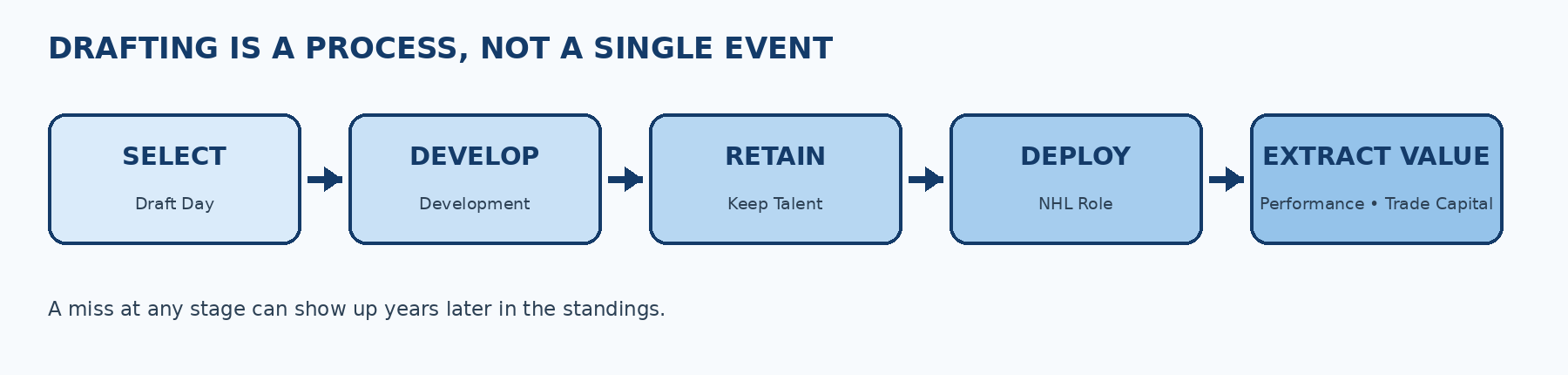
That points toward a more useful way to evaluate drafting. It is a chain, and failure at any point can produce the same eventual problem: no inexpensive internal replacement, no succession plan, less trade capital and more roster holes filled externally.
Open this graphic at full size
A bad draft may not hurt the Leafs the following October; its consequences can take years to appear. In 2011 Toronto traded picks 30 and 39 to Anaheim to move up to No. 22 for Tyler Biggs. Anaheim used those picks on Rickard Rakell and John Gibson; Biggs never played an NHL game. One decision did not create decades of inconsistency, but it illustrates the point: drafting is a lead indicator. The standings come later.
Great Teams Feed One Generation Into the Next
Good organizations do not hit on every draft pick. They hit often enough that the next generation is developing while the current one is winning: a veteran declines and a younger player arrives; an expensive contract creates pressure and an inexpensive internal player fills the role.
Toronto struggled for decades to sustain that cycle. Sometimes it missed on the player; sometimes it found the player but failed to develop him; sometimes it developed the player and failed to retain the value; and sometimes it traded the future in pursuit of the present. The individual decisions changed, but the long-term effect often did not: Toronto repeatedly lacked the organizational continuity required to turn one good Leafs team into the next good Leafs team.
The Milestones Nobody Reached
Player tenure tells a similar story. Despite being one of the NHL's oldest franchises, Toronto has never had a player score 500 goals or accumulate 1,000 points as a Maple Leaf. Expansion franchises decades younger have produced players who crossed those milestones.
Mats Sundin came closest on the points side, finishing his Leafs career with a then-franchise-record 987 points. Auston Matthews has since passed Sundin's franchise goal record, but 500 remains ahead of him. Perhaps the milestone itself is not the most interesting statistic. The process required to reach it is.
1,000 points are the lag metric. Tenure is the lead indicator.
You do not get a 1,000-point Maple Leaf without first creating an organization in which an elite player remains a Maple Leaf long enough to score 1,000 points. Toronto has produced great players — Dave Keon, Darryl Sittler, Lanny McDonald, Wendel Clark, Doug Gilmour and Mats Sundin among them — but collectively their stories reveal a historical peculiarity: Toronto has produced great players more often than it has produced lifelong great Leafs.
The Organization Shanahan Inherited
The Ballard Years: When the Incentives Were Different
No honest examination of Toronto's post-1967 history can avoid Harold Ballard. The Leafs still produced excellent players during his years, but the organization also became associated with instability, fractured relationships and decisions difficult to reconcile with a modern conception of a championship organization. There was also an unusual economic reality: Maple Leaf Gardens could fill even when the Leafs were not very good.
That does not mean nobody wanted to win. It does raise a fair organizational question: what happens when the economic penalty for losing is weaker than it is almost anywhere else? Bad decisions can survive longer, poor organizational lead indicators can accumulate, and the damage sometimes does not reveal itself until years later.
The Corporate Leafs Were More Complicated
The post-Ballard period deserves more nuance. There were serious attempts to win. The Gilmour Leafs contended, the Sundin-Quinn teams contended, and Toronto spent heavily in the pre-salary-cap NHL. It would be unfair to suggest ownership during those periods simply did not care about winning.
Yet Toronto still struggled to create an internal talent pipeline capable of sustaining one competitive generation into another. After the 2004–05 lockout, the results became particularly bleak: from 2005–06 through 2015–16, Toronto reached the postseason just once. The Leafs did not merely need another good player. They needed a different organizational process.
He Didn't Just Tear Down the Roster
Shanahan's rebuild was organizational as well as on-ice. Within months, he hired 28-year-old Kyle Dubas as assistant general manager and parted ways with executives Claude Loiselle and Dave Poulin. Dubas later oversaw analytics, player personnel and development while also running the AHL Marlies.
The names and roles changed, but the larger point matters more than any one hire: Toronto was rebuilding the machinery that identified, evaluated, developed and supported players. That belongs in the lead-indicator story too.
Shanahan Inherited More Than a Bad Hockey Team
Brendan Shanahan became Maple Leafs president in April 2014. The transformation was not immediate. Toronto tore down the roster and finished last overall in 2015–16, producing the first overall pick and Auston Matthews.
William Nylander had already been drafted eighth overall in 2014. Mitch Marner followed at No. 4 in 2015 and Matthews arrived first overall in 2016. In 2016–17, all three produced at least 60 points as rookies — only the second trio from one team in NHL history to accomplish that in the same season. That was more than a good rookie class. It was something Toronto had spent years searching for: an internally built generation.
Then the Leafs Started Doing Things They Hadn't Done in Generations
This is where the Shanahan era has to be judged against what came before it. Individual awards do not replace Stanley Cups, but elite teams generally require elite players. For decades Toronto had gone without several markers of elite individual performance. Then they began appearing.
Swipe or scroll across to see all columns.
| Milestone | Shanahan-era achievement | Historical significance |
|---|---|---|
| Calder Trophy | Auston Matthews — 2017 | First Maple Leaf Rookie of the Year since Brit Selby in 1966. |
| Hart Trophy | Auston Matthews — 2022 | First Maple Leaf NHL MVP since Ted Kennedy in 1954–55. |
| Rocket Richard | Matthews first won in 2020–21 and later won three times | First Maple Leaf to lead the NHL in goals since Gaye Stewart in 1945–46. |
| 60 goals | Matthews became the first Leaf to reach 60 | A franchise first despite several previous 50-goal scorers. |
| 69 goals | Matthews — 2023–24 | New Leafs single-season record. |
| Team wins | 54 — 2021–22 | Franchise record. |
| Team points | 115 — 2021–22 | Franchise record. |
| 100-point seasons | Three consecutive under Sheldon Keefe | A level of regular-season consistency the franchise had never previously sustained. |
| Division titles | 2020–21 North; 2024–25 Atlantic | Restored Toronto to the top of its division. |
| Postseason streak | Nine consecutive appearances beginning in 2016–17 | Longest Leafs playoff streak since the championship era. |
These are not Cups. They are evidence of direction: elite young talent, league-leading individual performance, record-setting regular seasons, division titles, roster continuity and repeated playoff access. They are not substitutes for the ultimate result; they are conditions that can make it possible.
Culture Was Changing Too
Not every lead indicator fits neatly into a spreadsheet. Culture has no xG percentage, but organizations communicate what they value. During the Shanahan era, Toronto began reconnecting its present with its past.
Dave Keon — whose relationship with the club had been fractured for decades — returned to the Maple Leafs family and joined Legends Row in 2016. That same year, the franchise changed its longstanding practice of honouring great players' numbers rather than permanently retiring them, retiring 11 numbers representing 17 players and adding Keon's No. 14.
Retiring Dave Keon's number did not make the Leafs better the following night. That is the wrong measurement. Culture is not the lag result; it is part of the organizational environment that precedes it. Before asking players to understand what it means to be a Maple Leaf, perhaps the franchise itself has to demonstrate that it understands what being a Maple Leaf means.
And Then the Players Stayed
This may be one of the most underappreciated changes. Matthews stayed. Nylander stayed. Morgan Rielly stayed. Marner stayed through almost the entire competitive window. The Core Four construction can be legitimately criticized, but Toronto did something it had historically struggled to do: identify elite players, develop them and keep a recognizable nucleus together long enough to define an era.
Continuity matters. You cannot build chemistry over eight years if the roster is rebuilt every three. You cannot produce 500-goal Leafs or 1,000-point Leafs if stars repeatedly finish their prime somewhere else. And you cannot establish an organizational standard if every disappointing season produces another identity crisis.
The Highlander Organizational Model
The Shanahan-era process can be viewed as a chain. The important point is that the Cup sits at the end of it, not at the beginning. Management controls the conditions more directly than it controls the final outcome.
Swipe or scroll across to see all columns.
| Stage | What it includes | What it is trying to produce |
|---|---|---|
| LEAD INDICATORS | Draft & identify talent; develop; retain; build continuity; create culture and identity | A sustainable organizational foundation |
| INTERMEDIATE RESULTS | Elite individual performance; 100-point seasons; division contention; repeated playoff qualification | Repeated opportunities to contend |
| LAG RESULTS | Win playoff rounds; reach Conference Final; reach Stanley Cup Final; win Stanley Cup | Championship success |
Toronto moved significantly further down this chain than it had for most of its post-1967 history. And then the chain broke.
Where the Model Broke
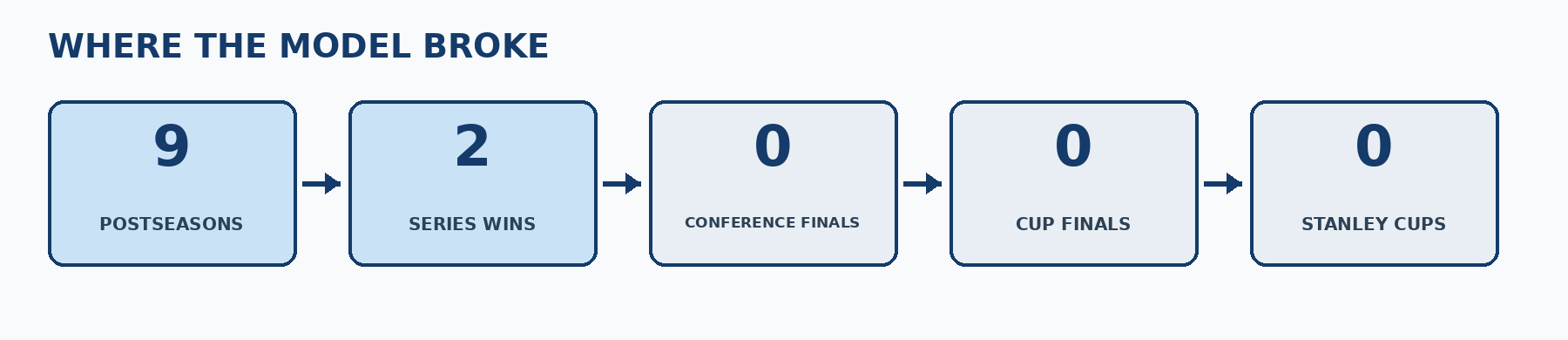
Open this graphic at full size
Those numbers cannot be dismissed. When Shanahan left in 2025, he said plainly that he had come to Toronto to help win a Stanley Cup and had not finished the job. That is the standard for the ultimate objective. The accomplishments matter, and so does the failure to reach it.
When Continuity Becomes Inertia
There is another lesson in the lead-metric framework: a lead indicator is not automatically positive forever. Keeping great players, continuity and patience are usually good — until the evidence begins saying otherwise.
Toronto repeatedly returned with essentially the same star core after postseason disappointment. There were defensible reasons: elite players are difficult to replace, trading one can make a team worse, and the regular-season evidence suggested this group could win. But eventually an uncomfortable question emerged: at what point does continuity stop being a strength and become inertia?
That is also part of the Shanahan legacy. The same patience that allowed Toronto to build its most sustained winning era in generations may also have contributed to the organization's reluctance to change a formula that repeatedly failed in the playoffs. Two things can be true.
Their Success Created Our Frustration
Imagine telling a Leafs fan in 2015 what was coming. Toronto would draft one of the greatest goal scorers of his generation. He would become the first Leafs Rookie of the Year since before the last Stanley Cup, the first Leafs MVP since 1955 and the first Leaf to lead the NHL in goals since 1946. He would score the first 60-goal season in franchise history and then score 69.
Toronto would set franchise records for wins and points, win division titles and make the postseason nine consecutive times. Matthews, Nylander, Marner and Rielly would form a recognizable core that remained together through most of a competitive decade. The question every spring would no longer be whether the Leafs could make the playoffs. It would be whether they could win the Stanley Cup.
Most Leafs fans in 2015 probably would have accepted that future immediately. Now tell them one more thing: they still would not reach the third round.
There is the entire era.
Success Changed the Definition of Failure
This may be the most important thing the Shanahan era changed. When a team regularly misses the playoffs, qualifying is success. When it qualifies every year, qualification becomes the minimum. When it produces 100-point seasons and employs elite players in their primes, winning one round no longer feels like enough.
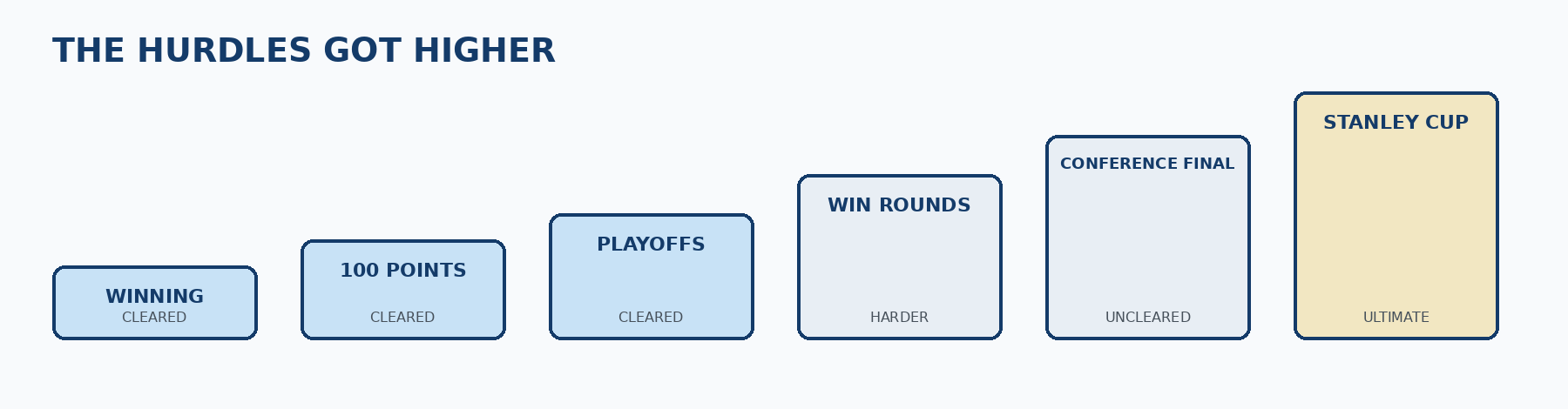
The hurdles got higher because the Leafs kept clearing the old ones. Winning seasons stopped feeling exceptional. Then 100-point seasons did. Eventually making the playoffs was no longer the destination either. The next hurdles were winning rounds, reaching the Conference Final and playing for the Stanley Cup. Their accomplishments raised expectations; those expectations produced frustration; and that frustration is evidence of how different Toronto had become.
Open this graphic at full size
Then Winning Stopped Being Normal
In 2025-26, Toronto missed the playoffs for the first time since 2016. Suddenly the Leafs stumbled over a hurdle everyone had stopped noticing: making the playoffs. Winning 50 games is not automatic. Producing 100-point seasons is not automatic. Having elite players remain together through their prime is not automatic.
Even being disappointed with a division-winning team because it did not go deep enough is not automatic. The Shanahan-era Leafs made those things feel ordinary. Perhaps they were not.
The Legacy Is Still Being Written
Brendan Shanahan is gone, but organizational legacies do not necessarily disappear with the executive who created them. The players can outlast the administration. Matthews is still here. Nylander is still here. And now Gavin McKenna represents another generation.
For more than a century, Toronto has never had a player score 500 goals in a Leafs sweater, and no Leaf has ever accumulated 1,000 points as a Leaf. Matthews could become the first to reach 500. Could Matthews eventually reach 1,000 points? Could Nylander? Looking much further down the road, could McKenna someday become another player whose career and the franchise become inseparable?
Those are possibilities, not predictions. But their plausibility tells us something: franchise records require more than talent. They require time, stability and continuity.
And Maybe One More Number Finally Changes
There is, of course, another number — the one that matters most. Toronto has not reached the third round of the playoffs since 2002. It has not reached the Stanley Cup Final since 1967 and has not won the Stanley Cup since that same spring.
No Legends Row statue, retired number, individual award or franchise record changes that. None is a substitute for a championship.
But perhaps they are evidence that some of the organizational conditions underneath the ultimate result have improved. Maybe the next milestone is finally the one Toronto has waited generations to see: a third-round series victory, a conference championship and, God willing, the Stanley Cup.
What Did the Shanahan Era Actually Accomplish?
It did not accomplish what it ultimately set out to accomplish. There is no championship banner, no Stanley Cup Final and not even a conference-final appearance. By the ultimate lag metric, the objective was not achieved. Shanahan did not make Stanley Cup success a reality in Toronto. He helped make it a realistic possibility - repeatedly.
But Brendan Shanahan inherited more than a championship drought. He inherited habits that helped make it durable: instability, fractured relationships with the franchise's past, inconsistent drafting and development, too little continuity and long stretches in which merely reaching the postseason represented progress.
He did not solve all of them, but he changed enough to matter. Toronto built an elite young core, produced long-missing individual honours, set franchise records for wins and points, created its longest postseason streak since the last Stanley Cup, reconnected with Dave Keon and retired the numbers of its greatest players. More important than any single milestone, the Shanahan era made sustained contention feel realistic rather than occasional. The ultimate hurdle was the one it could never clear.
And perhaps most significantly: winning became normal.
Maybe Matthews becomes the first 500-goal Leaf. Maybe Matthews or Nylander becomes Toronto's first 1,000-point player. Maybe McKenna someday joins them as another great player whose story does not need to finish elsewhere. And maybe a future Leafs team finally does what none has since 1967: play for — and win — the Stanley Cup.
If that happens, it will not retroactively give Shanahan a championship or erase the playoff failures of his era. But it may become part of his legacy. Perhaps his most consequential accomplishment was not ending 1967, but beginning to erase some of the organizational habits that helped it last so long.
The ultimate lag metric never arrived on his watch. But the lead indicators moved. The culture and regular-season standard moved. Expectations moved with them. For decades, Toronto too often asked how to become good again. The Shanahan-era Leafs forced a harder question:
How do we turn good into great?
That's progress. It's also unfinished business — because 1967 is still waiting.
Hold Fast. Think Sharp. See the Game Clearly.