


In this report
For years, the Toronto Maple Leafs have carried a familiar identity: elite talent at the top, high-end offensive skill and a roster capable of overwhelming opponents when its stars were rolling—but too often unable to control games when they weren’t.
The 2025–26 season exposed that weakness more dramatically than most. Toronto finished 32-36-14, last in the Atlantic Division, allowed 3.60 goals per game and controlled just 45.2 percent of the expected goals at five-on-five. That last number should be the starting point for any serious discussion of what the Maple Leafs did this summer.
Because Toronto didn’t simply add players. It changed the general manager, added a franchise icon to hockey operations, replaced the head coach and much of his staff, rebuilt significant parts of the roster, changed its goaltending and overhauled the performance structure surrounding the players. It also added first-overall pick Gavin McKenna and committed eight years to Darren Raddysh after his 70-point season in Tampa Bay.
So the question is no longer simply whether the Leafs added enough talent. It is whether they changed the environment in which that talent plays. That is where expected goals become useful—but not in isolation. If Toronto wants different results, it first has to change the repeatable behaviours that produce those results. Lead metrics tell us whether the process is changing. Lag metrics tell us what that process eventually produces.
The Problem: Toronto Wasn’t Merely Unlucky
Toronto’s 2025–26 season was not simply a collection of bad bounces. The Leafs scored 3.07 goals per game, but allowed 3.60. At five-on-five they were badly out-attempted, generated fewer quality chances than they conceded and lost the high-danger areas. The overall picture was a team that too often required its best players to overcome the flow of the game rather than benefit from it.
Swipe or scroll across to see all columns.
| Metric | 2025–26 Toronto | What it tells us |
|---|---|---|
| Record | 32-36-14 | Last in Atlantic |
| Goals/game | 3.07 | Offence was not the largest problem |
| Goals against/game | 3.60 | Major defensive problem |
| Power play | 21.32% | Roughly league average |
| Penalty kill | 81.22% | Respectable |
| 5v5 Corsi share | 45.5% | Badly out-attempted |
| 5v5 xGF | 163.2 | Below-average chance generation |
| 5v5 xGA | 198.0 | Major chance-suppression problem |
| 5v5 xG share | 45.2% | Lost the territorial battle |
| 5v5 scoring-chance share | 45.6% | Confirms broader problem |
| 5v5 high-danger share | 46.1% | Lost dangerous areas |
The significance of 45.2 percent is not that xG is a magic number. It is that the figure summarizes a much broader problem. Toronto needed to create more, concede less and spend less time asking Auston Matthews, William Nylander and the rest of the top six to repair deficits created elsewhere.
The Rebuild Behind the Rebuild
Toronto’s transformation began above the roster. John Chayka replaced Brad Treliving as general manager, while Mats Sundin returned as Senior Executive Advisor, Hockey Operations. Chayka brings an explicitly analytical background, including co-founding the hockey-data company Stathletes, while Sundin’s role includes strategic advice with an emphasis on team culture, player development and leadership support. The current hockey operations group also includes Brad Rossen as Vice President of Research and Development and dedicated hockey R&D analysts.
The coaching reset was similarly broad. Jim Hiller replaced Craig Berube and was joined by associate coach Daniel Alfredsson and assistants John Gruden and Brad Werenka. Werenka’s appointment is particularly relevant to this article’s premise: Hiller specifically cited his combination of NHL experience, player development and performance analytics. Toronto is not merely changing who stands behind the bench; it is changing the information and expertise feeding into that bench.
Then came a quieter but potentially important overhaul of Sport Performance. Andy O’Brien was hired as Vice President, Sport Performance, with responsibility spanning strength and conditioning, sport science, nutrition, injury rehabilitation and mental performance. Dr. Craig Slaunwhite joined as Director, Health and Performance Integration, Jason Martin as head strength and conditioning coach, Josh Crouse as his assistant and Dr. Jordan Shallow as a human-performance consultant. NHL.com described the wider summer as a makeover stretching from the front office to the coaching staff to the ice, with more than two dozen personnel changes on and off the ice by training camp.
That matters because repeatable hockey behaviours are not created by roster construction alone. Coaching affects systems and deployment. Analytics can identify which behaviours are producing better outcomes. Development determines whether young talent can turn skill into NHL habits. Strength, conditioning, recovery and sport science influence whether those habits can be executed consistently across an 84-game season.
The players provide the tools. The new organization around them is supposed to help determine how those tools are developed, deployed, measured and sustained.
Jim Hiller: Turning the Reset Into a System
Hiller therefore becomes the bench-level test of the entire rebuild. There is no responsible way to assign a coach a neat figure such as “+0.08 expected goals per game.” The better approach is to watch the behaviours a coach can influence: cleaner defensive-zone exits, more successful retrieval-to-exit sequences, controlled offensive-zone entries, fewer rush chances against, stronger slot protection, more forecheck recoveries and better territorial results from the bottom six.
That distinction will matter early. A 7-5 record could conceal the same structural weaknesses that hurt Toronto last season, while a 5-7 start could include meaningful improvement obscured by poor shooting or goaltending. The useful question is not simply whether Toronto is winning. It is whether the Leafs are playing in ways that should make winning more sustainable.
Raddysh and the First Pass
Darren Raddysh arrives after a remarkable 22-goal, 70-point season in Tampa Bay. That breakout demands some caution—70 points nearly matched the 73 he had produced in his previous 176 NHL games—but Toronto does not need to assume another 70-point season for the acquisition to matter. His greater importance may be what happens immediately after the Leafs recover the puck.
Toronto’s defence too often treated prevention and transition as separate problems. A defensive stop has limited value if the next pass immediately returns possession to the opponent. Raddysh and Emil Andrae suggest a greater emphasis on mobility and puck movement: turn retrievals into clean first passes, clean first passes into controlled exits, and controlled exits into attacks before the opposition can establish its structure. That chain can increase offence without asking the forwards to manufacture every chance from a standing start.
McKenna Changes the Possibilities
Gavin McKenna is the largest variable in Toronto’s offensive ceiling. The first-overall pick produced 51 points in 35 NCAA games, but NHL impact is a different question. The early evaluation should therefore be less about whether he immediately reaches a particular point total and more about whether his skills survive NHL pressure: can he carry the puck through neutral ice, create controlled entries, find the middle and generate possession before defensive structures become established?
McKenna does not have to replace a previous star one-for-one. He has to add a dimension Toronto did not possess often enough last season. If he can do that quickly, the Leafs become less dependent on Matthews and Nylander creating offence from static situations and more capable of attacking in transition.
Knies, Cowan and Internal Growth
Toronto’s upside also depends on players already inside the organization. Matthew Knies does not need to become a different player; Toronto needs to put him in more situations where puck protection, net-front presence, forechecking and interior attacks lead to sustained offensive-zone possession. His progress may show up in offensive-zone recoveries, slot touches and high-danger chances before it appears dramatically in his point total.
Easton Cowan presents a different opportunity through controlled entries, puck recoveries and transition support. Neither player needs an arbitrary xG value assigned to his development. They matter because Toronto’s offensive improvement does not have to come exclusively from its offseason acquisitions.
The internal-growth story also extends beyond Knies and Cowan. Toronto's Calder Cup-winning Marlies gave several younger players meaningful experience in a winning environment. Ben Danford gained playoff experience on the championship run, while Luke Haymes - signed out of Dartmouth College - earned an April NHL recall and appeared in four games after a productive first full AHL season. Goaltender Artur Akhtyamov, the Calder Cup playoff MVP, adds another young option pushing from below. None of them has to become a star immediately; if even one or two become dependable NHL contributors, Toronto gains inexpensive depth and genuine competition for jobs.
The Bottom Six: Stop Handing the Stars a Deficit
Toronto's reconstruction may be most visible when its superstars are resting. Nick Paul, Teddy Blueger, Brandon Duhaime and Colton Sissons are not individually the defining moves of the summer, but collectively they reveal what management wants its depth group to become: harder on the forecheck, more defensively responsible, more useful on faceoffs and special teams, and better able to support transition. Jack Roslovic should be treated differently. His speed and offensive ability give Hiller the flexibility to use him higher in the lineup, including alongside skilled players, rather than defining him in advance as a bottom-six forward.
A bottom-six line does not need to score to have a successful shift. Sometimes its most valuable contribution is to leave the rink near territorial break-even and hand the next shift to Matthews or Nylander without a problem to repair. On a team with elite offensive talent, neutral can be valuable. The stars should not constantly be asked to fix what happened before they stepped over the boards.
The Defence: Prevention Is Only Half the Job
A healthy Chris Tanev still gives Toronto an experienced defensive presence capable of difficult assignments, but health is an essential qualifier after he played only 11 games last season. Behind him, the Raddysh and Andrae additions point toward more mobility and puck movement. That does not make outgoing defenders such as Brandon Carlo or Simon Benoit ineffective; it suggests a philosophical change in what Toronto wants its defence to do after winning the puck.
Morgan Rielly may be one of the more interesting tests of the new structure. Perhaps he still deserves a seat on this bus; the more important question is whether Toronto can finally put him in the right seat. For much of his career, Rielly has been asked to carry the expectations of a definitive No. 1 defenceman while also driving offence and transition. A deeper, differently constructed blue line may allow Hiller - who previously coached Rielly in Toronto - to lean more heavily on what Rielly still does well instead of asking him to compensate for every weakness around him. The economics have changed as well: his $7.5-million cap hit now sits within a $104-million ceiling, making the contract less imposing as a share of the cap than it once appeared.
The key sequence is simple: defensive stop, retrieval, first pass, controlled exit, transition, controlled entry, scoring opportunity. Toronto’s 2025–26 numbers suggest it needs to become better across that entire sequence, not merely at the first step.
The Performance Chain
Expected goals sit in the middle of the story, not at the beginning. The behaviours below are what Toronto can change first; the standings are what eventually tell us whether those changes were enough.
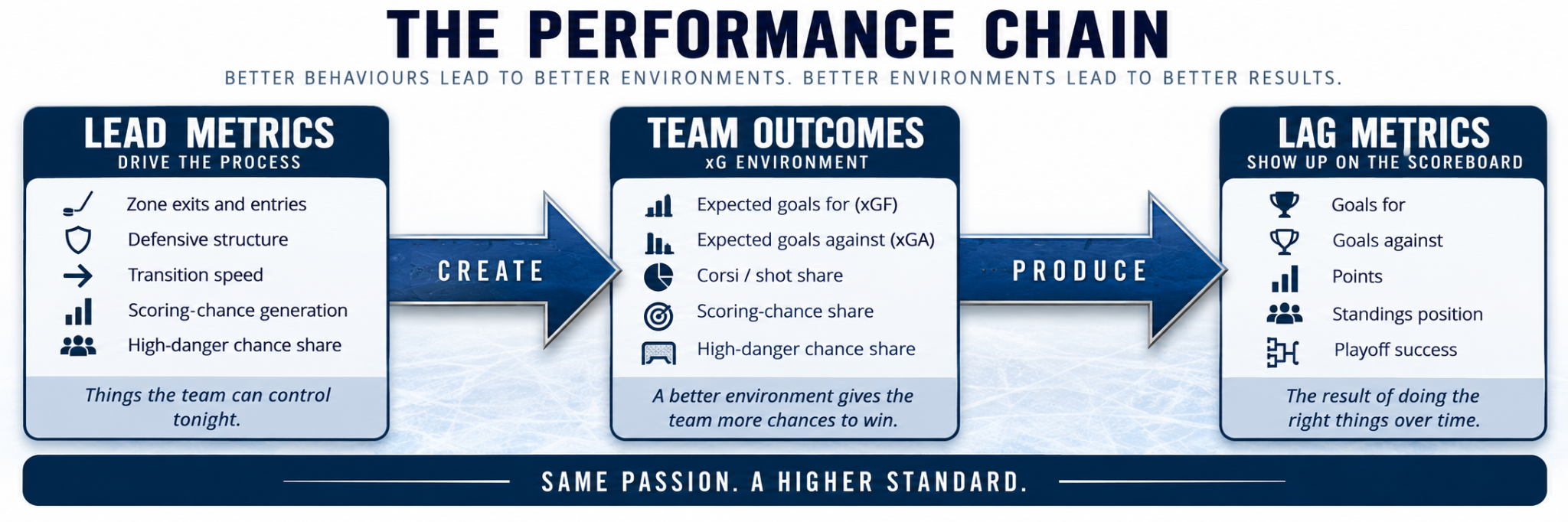
Open the performance-chain graphic at full size
Short-term results can lie. Hot shooting can hide mediocre offensive process; hot goaltending can hide poor defensive structure; a run of one-goal losses can make improved underlying play look worse than it is. The lead metrics tell us whether the machine itself is functioning better. Over time, a better machine should create better outcomes.
What Would Real Improvement Actually Look Like?
Rather than claiming that individual additions are worth precise fractions of an expected goal, it is more useful to ask how much Toronto’s entire five-on-five environment must improve. The 2025–26 baseline was 163.2 expected goals for and 198.0 expected goals against—approximately 1.99 xGF and 2.41 xGA per game, or a 45.2 percent share.
Swipe or scroll across to see all columns.
| Scenario | Offence | Defence | xGF/G | xGA/G | xG share |
|---|---|---|---|---|---|
| 2025–26 actual | — | — | 1.99 | 2.41 | 45.2% |
| Low case | +5% | 4% fewer xGA | 2.09 | 2.32 | 47.4% |
| Base case | +10% | 8% fewer xGA | 2.19 | 2.22 | 49.6% |
| High case | +14% | 12% fewer xGA | 2.27 | 2.12 | 51.6% |
The point of the model is not to pretend we know the exact outcome. It is to define what meaningful improvement would look like. At roughly 47 percent, Toronto would be better but still structurally vulnerable. Around 50 percent, the Leafs would be close to territorial break-even and their elite finishers would be operating on a much healthier foundation. Above 51 percent, the structure itself begins to look like an advantage rather than something the stars must overcome.
Low, Base and High: Three Ways the Reset Could Develop
Low case · 47.4%
In the low case, Raddysh helps the puck movement but regresses substantially from 70 points, McKenna shows flashes while making a normal 18-year-old adjustment, Tanev struggles to stay healthy and the new bottom six becomes more reliable without consistently winning its minutes. Hiller improves parts of the structure, but Toronto still spends too much time defending. The Leafs move toward 47.4 percent of five-on-five expected goals: better, but not transformed.
Base case · 49.6%
The base case does not require perfection. Raddysh improves the first pass, McKenna becomes a legitimate transition creator, Knies continues to grow, Cowan contributes, the bottom six spends less time trapped and Tanev plays enough to stabilize difficult minutes. Cleaner exits, more controlled entries and fewer dangerous chances against push Toronto toward 49.6 percent. That might not sound revolutionary, but compared with 45.2 percent it would represent a major change. Toronto does not need to dominate possession; it needs to stop being dominated.
High case · 51.6%
The high case is where the offseason becomes genuinely transformative. McKenna adapts quickly, much of Raddysh’s breakout proves sustainable, internal development hits, the depth lines approach or exceed break-even and Hiller combines stronger defensive structure with Toronto’s existing offensive talent. At roughly 51.6 percent, the Leafs are no longer asking Matthews and Nylander to overcome a structurally weak team. The structure itself becomes part of the advantage.
What to Watch Once the Games Count
The most useful way to revisit this thesis during the season is not to check the standings alone. Watch whether the behaviours underneath the standings are changing.
Swipe or scroll across to see all columns.
| Lead metric | Improvement should look like | Likely downstream effect |
|---|---|---|
| Defensive-zone exits | More clean exits with possession | xGF / shot share |
| Controlled entries | More attacks beginning with control | Scoring chances / xGF |
| Retrievals | Stops becoming first passes and exits | xGA and xGF |
| Slot protection | Fewer slot and rebound opportunities | xGA / goals against |
| Rush differential | More rush chances created than conceded | xGF / xGA |
| Forecheck recoveries | More recoveries below the circles | Offensive-zone time |
| Bottom-six territorial play | Depth closer to break-even | Team xG share |
If Toronto starts 10-5 while most of these indicators remain poor, caution is warranted. If the Leafs begin 7-8 while exits, entries, slot protection and territorial play have materially improved, the standings may be understating the progress. The point is not to dismiss wins and losses. It is to understand what is producing them.
Bobrovsky: The Variable Outside the xG Model
Sergei Bobrovsky belongs in the discussion, but he should be kept analytically separate from Toronto’s five-on-five xGA. The two-time Vezina Trophy winner and two-time Stanley Cup champion arrives after a difficult season in which he went 27-23-1 with a 3.07 goals-against average and an .877 save percentage. Toronto is not simply importing “elite goaltending”; it is betting that an accomplished goaltender can rebound.
The team and its system largely determine the quality of opportunities it allows. The goaltender determines how efficiently those opportunities become actual goals. Toronto could dramatically improve its slot protection and rush defence while Bobrovsky struggles, leaving the goals-against column looking worse than the process. The reverse is also possible: brilliant goaltending could disguise a defence still surrendering too much dangerous ice. Over a short stretch, process and result can tell different stories.
Bobrovsky may also provide something the model cannot easily quantify: time. New systems, new defence partners and new support reads rarely become instinctive in September. Toronto's lead indicators could begin moving in the right direction before the standings fully reflect the change; cleaner exits and better slot protection do not guarantee that every early mistake disappears. An experienced goaltender can keep the ship afloat during that adjustment. The Leafs do not need Bobrovsky to disguise poor hockey indefinitely. They may need him to make a few additional saves while the right behaviours are taking hold but have not yet produced the expected results.
The Most Important Number May Still Be 45.2%
There will be plenty of temptation to focus on Toronto’s ceiling. Can McKenna become a star immediately? Can Raddysh repeat his breakout? Can Bobrovsky rebound? Those are reasonable questions, but the more important analytical question may be simpler: can Toronto move from 45.2 percent of the expected goals toward 50 percent?
That represents much more than four or five percentage points. It would mean the Leafs are no longer structurally dependent on their stars overcoming the rest of the game. It would mean Toronto has become competitive in the minutes between Matthews’ and Nylander’s highlight-reel plays. And the first clues will appear before the standings fully reflect them—in cleaner exits, better entries, fewer rush chances against, stronger slot protection, more offensive-zone recoveries and depth lines that survive their minutes.
Years ago, Oldsmobile tried to change public perception with a simple idea: this was not the Oldsmobile people thought they knew. Toronto’s offseason carries a similar message. The organization has changed management, coaching, analytics and performance infrastructure as well as the roster. None of it guarantees success, and a 45.2 percent baseline should prevent anyone from pretending the Leafs are starting from a position of strength. But it does make the coming season unusually revealing.
Toronto’s wager is not simply that different players will produce different results. It is that different personnel, developed and deployed within a different system and supported by a different organization, will create different repeatable behaviours.
Those behaviours are the lead metrics. Expected goals are the bridge. Goals and wins are the lag metrics.
That is what we should be watching in 2026–27—not simply whether Toronto wins, but whether the way Toronto plays is becoming more likely to produce wins. If the process changes first, the results may finally have something sustainable underneath them.
This is not your father’s Maple Leafs.
Hold Fast. Think Sharp. See the Game Clearly.
Sources
- Hockey-Reference — 2025–26 Toronto Maple Leafs team statistics and five-on-five analytics.
- Toronto Maple Leafs / NHL.com — MLSE Announces New Toronto Maple Leafs Leadership (May 3, 2026).
- Toronto Maple Leafs / NHL.com — Maple Leafs Announce Coaching Staff Additions (July 7, 2026).
- Toronto Maple Leafs / NHL.com — Maple Leafs Announce Additions to Sport Performance Department (Aug. 3, 2026).
- NHL.com — Inside look at Toronto Maple Leafs, 32 in 32 (Aug. 27, 2026).
- NHL.com — John Chayka interview on Maple Leafs GM role and organizational changes (Sept. 14, 2026).